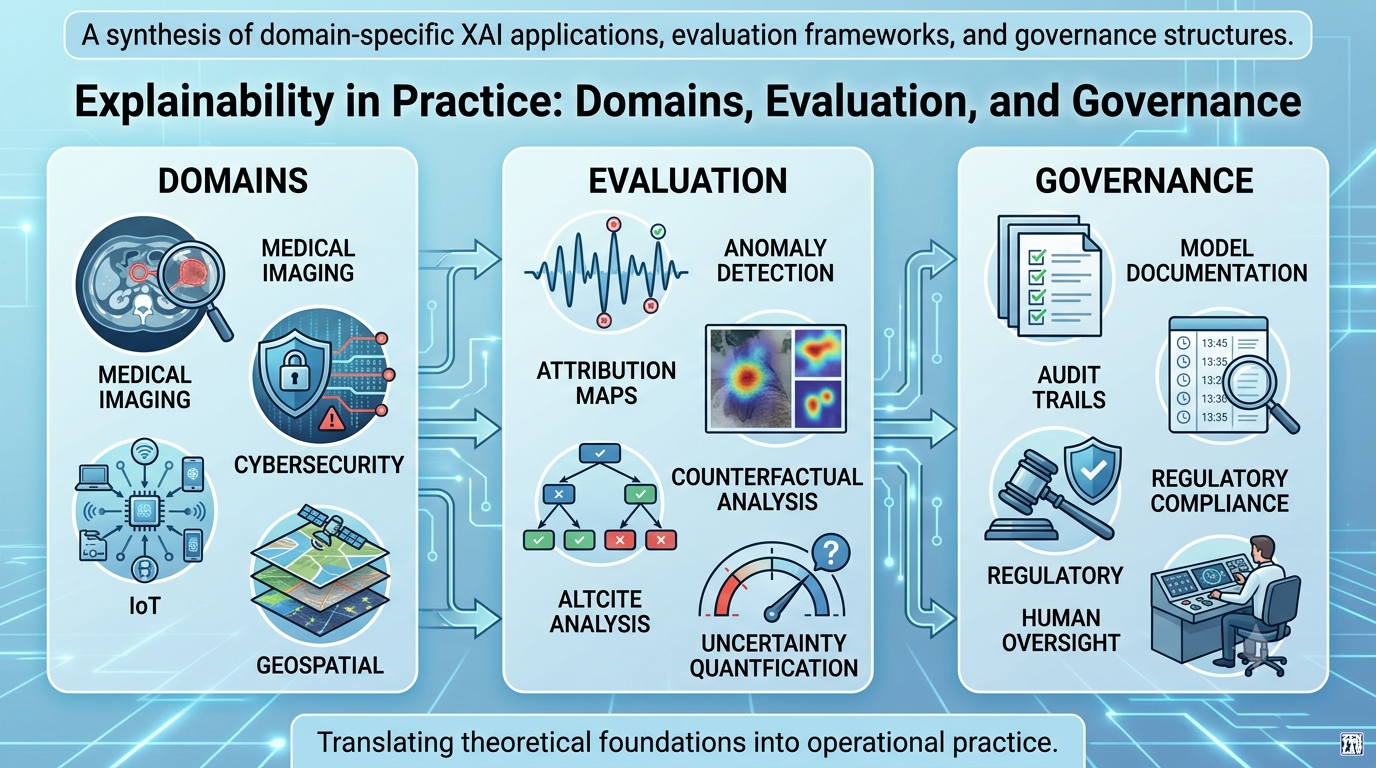
The previous articles established foundations, methods, and limits. This article examines how XAI is applied in practice across domains, how it is evaluated, and what governance structures are needed. Domain applications from medical imaging to cybersecurity demonstrate that XAI requirements are fundamentally domain-dependent. Evaluation work (including Salvi et al. on uncertainty and the metrics analysis of Pawlicki et al.) shows that no universal metric set exists and that metrics must be chosen for the specific use case. Governance structures from Casper et al. and Bhatt et al. establish that transparency, access, and accountability require organisational commitment beyond any technical solution.
Introduction
The first three articles in this series established what XAI means, how it works, and where it falls short. This article answers the practitioner’s question: what do you actually do? The answer is not a single recommendation but a situated decision framework.
Domain applications demonstrate that XAI requirements vary fundamentally by context. Evaluation frameworks show that metrics must be chosen for the specific use case, not adopted from a menu. Governance structures reveal that organisational commitment matters as much as technical capability. The synthesis draws on domain surveys covering medical imaging, cybersecurity, and IoT; evaluation frameworks linking explainability with uncertainty quantification; and deployment studies that characterise how organisations currently use XAI.
This article is not legal advice.
Vocabulary for XAI Practice
- Uncertainty-aware explanation
- An explanation that quantifies the confidence in its own attribution scores, following the thesis of Salvi et al. that explainability and uncertainty are "two sides of the same coin."
- Model documentation
- Structured records of model purpose, development data, performance characteristics, and known limitations. Model Cards and Datasheets are prominent examples. Documentation is a governance mechanism that does not require explanation methods.
- Feature governance
- The organisational practice of documenting, monitoring, and controlling which features are used in ML models, including periodic review of feature relevance, data quality, and drift.
- Accountability
- The organisational infrastructure that ensures someone is responsible for model decisions, independent of whether the model is explainable. Accountability structures include escalation paths, audit trails, and designated human-in-the-loop roles.
Domain-Specific XAI Requirements
Medical Imaging and Clinical Decision Support
Medical XAI surveys (Hossain et al. 2025; Tjoa & Guan 2021; Nazir et al. 2023) reveal that healthcare presents uniquely demanding XAI requirements. Explanations must be faithful enough to support clinical decisions, interpretable enough for clinicians with limited ML training, and robust enough to withstand regulatory scrutiny under frameworks like the EU Medical Device Regulation.
The dominant approach in medical imaging combines Grad-CAM or LRP visualisations with clinician evaluation. This approach faces the Clever Hans problem documented by Lapuschkin et al.: models can learn to base decisions on spurious, task-irrelevant artefacts (in the original demonstrations, a source tag overlaid in horse images and shortcut strategies in Atari games) rather than the content the practitioner intends, while scoring well on standard metrics. Clinicians who trust these visualisations may develop overconfidence in models that rely on such spurious correlations.
The critique of Ghassemi et al. (discussed in Critical Perspectives and Limits of Current Explainability Methods) poses a challenge that the medical XAI community has not fully answered: if explanations can be systematically misleading and clinicians cannot evaluate their reliability, do explanations in their current form improve or degrade clinical decision-making?
Cybersecurity
Cybersecurity presents a different set of challenges. Pawlicki et al. evaluate XAI evaluation metrics in a cybersecurity context and find that metric selection matters acutely in this high-stakes domain. The evaluation metrics that work in one setting may be inappropriate for the tabular intrusion-detection data common in security, and several metrics yield no meaningful results on such data. The central findings of the paper are metric duplication, metric inefficacy, and metric confusion, not a single speed requirement.
Feature attribution methods (SHAP, LIME) dominate security XAI, but the evaluation literature reveals that metric proliferation is particularly acute in this domain. Multiple metrics claiming to measure “faithfulness” produce systematically different rankings of the same methods applied to the same security data.
Internet of Things
IoT XAI (Kök et al. 2023) operates under severe resource constraints. Post-hoc explanation methods that require substantial compute can be hard to run on memory- and energy-limited edge devices. This has led to interest in intrinsically interpretable models (decision trees, rule lists) that provide explanations as a byproduct of their architecture rather than requiring separate post-hoc computation.
Geospatial and Environmental XAI
Roussel et al. (2025) propose a quality-aware XAI framework for geospatial analysis that incorporates machine learning quality metrics into the explanation process, so that explanations reflect not only model predictions but also their reliability, with case studies visualised using glyphs. This is a step toward linking explanation quality to the reliability of downstream decisions, which addresses part of the challenge Ghassemi et al. raise.
Evaluation Frameworks
Salvi et al. (2025): Explainability and Uncertainty as Two Sides of the Same Coin
Salvi et al. propose a framework unifying explainability with uncertainty quantification [2]. The thesis is that explanations without uncertainty bounds are fundamentally incomplete. As an illustration, a SHAP value of 0.3 for a feature carries a different meaning when the accompanying uncertainty is small than when it is large, which is why the authors argue reliability cannot be guaranteed by relying on explanations alone.
The framework operationalises this thesis for attribution-style explanations, which its authors demonstrate in detail. Test-time augmentation propagates aleatoric uncertainty into saliency maps, while ensembles and Monte Carlo dropout propagate epistemic uncertainty into multiple Grad-CAM maps, so the output shows which regions are certain and which are uncertain. The authors explicitly defer extending the approach to other explanation families, such as counterfactual explanations, to future work.
Dwivedi et al. (2023): Core Ideas, Techniques, and Solutions
Dwivedi et al. provide a broad survey emphasising practical solutions [3]. The paper organises the field around data explainability and model explainability, with feature-based and example-based technique families, and surveys the software toolkits and design considerations practitioners need to select and implement approaches for their use cases. This practical emphasis makes it a valuable complement to the conceptual and critical analyses discussed in previous articles.
Hassija et al. (2024): Model-Agnostic Methods for Black-Box Models
Hassija et al. focus specifically on interpreting black-box models [6]. Their survey covers model-agnostic methods including LIME, SHAP, partial dependence plots, accumulated local effects, and permutation feature importance. The emphasis on black-box methods reflects the practical reality that practitioners often cannot access model internals.
Governance Structures
Organisational Accountability
The deployment study of Bhatt et al. (Critical Perspectives and Limits of Current Explainability Methods) established that most XAI serves internal stakeholders. The constructive response is not to abandon XAI but to build organisational structures that redirect explanations toward the stakeholders who need them.
The stakeholder-centred framework of the paper is a governance mechanism: establish clear goals for what the explanation should achieve for a specific stakeholder; design for that stakeholder’s cognitive and domain context; evaluate whether the goals are met. This framework translates technical explainability into organisational accountability.
Access Governance
The three-level access framework of Casper et al. (black-box, white-box, outside-the-box) provides a governance structure for model auditing. Organisations deploying high-risk AI systems should establish policies determining what level of access external auditors require, with the default presumption that black-box access alone is insufficient for rigorous evaluation.
Regulatory Context
The EU AI Act establishes requirements for explainability and transparency that vary by risk category. High-risk AI systems must provide meaningful information about the logic involved in decision-making. The Act does not specify which explanation methods to use, creating both flexibility and uncertainty. Practitioners should design explanation pipelines that can adapt to evolving regulatory requirements.
Synthesis: Practice Requires Integration
The practitioner’s challenge is integrating these dimensions: selecting methods appropriate for the domain, choosing evaluation metrics that measure what matters for the specific use case, and building governance structures that ensure explanations reach the stakeholders who need them.
No single method, metric, or governance structure suffices. Domain determines method requirements. Use case determines metric selection. Organisational context determines governance design. The integration is the practice.
Conclusion
Explainability in practice is a situated, multi-dimensional challenge. Domain applications demonstrate that general-purpose XAI guidance is insufficient. Evaluation frameworks show that metrics must be chosen for the specific context. Governance structures reveal that organisational commitment is as important as technical capability.
The final article in this series examines where XAI is heading: the open challenges identified by the XAI 2.0 manifesto of Longo et al. and the emerging directions that will shape the field.
Frequently Asked Questions
What domain-specific requirements exist for XAI in medical imaging and clinical settings?
Medical imaging requires explanation methods that are robust to Clever Hans artifacts, produce spatially coherent attribution maps, and provide uncertainty quantification alongside explanations. Clinical deployment additionally demands explanations that align with medical reasoning workflows, regulatory compliance under frameworks such as the EU AI Act, and validation against established diagnostic standards rather than purely technical metrics.
How does the EU AI Act affect XAI deployment and governance requirements?
The EU AI Act classifies AI systems by risk level and imposes transparency obligations that include documentation of training data, model architecture, and intended use. For high-risk systems, it requires human oversight mechanisms and technical documentation of explainability properties. The Act creates legal accountability for explanation quality without prescribing specific technical standards, creating both pressure and flexibility.
What evaluation frameworks exist for assessing explanation quality in practice?
Three main frameworks have emerged: functionally-grounded evaluation using formal proxies such as faithfulness and completeness[1], human-grounded evaluation through user studies that measure how explanations affect human decision-making, and application-grounded evaluation in real deployment contexts. Surveys such as Dwivedi et al. (2023)[3] support practitioners in selecting and implementing these approaches for their use cases.
How does Salvi et al. connect explainability and uncertainty in their framework?
Salvi et al. (2025)[2] argue that explanations without uncertainty quantification are fundamentally incomplete because users cannot distinguish between confident model predictions and those near decision boundaries. Their framework integrates uncertainty estimates into explanation outputs by modifying attribution methods to propagate epistemic and aleatoric uncertainty through the explanation computation.
What governance structures are needed for responsible XAI deployment?
Effective governance requires organisational accountability mechanisms including designated explainability officers, access governance that matches explanation detail to stakeholder roles, documented decision frameworks for method selection, and regular audit cycles that verify explanations remain faithful after model updates. These structures bridge the gap between technical capability and responsible practice.
Appendix: Source Material
Author and Source Credibility
| Source | Profile | Venue | Focus |
|---|---|---|---|
| Salvi et al. (2025) | Multi-institution | Int. J. Medical Informatics | Uncertainty-XAI integration |
| Dwivedi et al. (2023) | Multi-institution | ACM Computing Surveys | Practical XAI solutions |
| Hassija et al. (2024) | Multi-institution Indian | Cognitive Computation | Black-box interpretation |
| Bhatt et al. (2020) | CMU/Cambridge/PAI | FAT* (FAccT) | Deployment practice |
| Casper et al. (2024) | MIT/Harvard | FAccT 2024 | Audit governance |
Domain Coverage
| Domain | Primary methods documented | Key challenge | Source examples |
|---|---|---|---|
| Medical imaging | Grad-CAM, LRP, saliency maps | Clever Hans artifacts, clinician trust | Hossain 2025, Tjoa 2021, Nazir 2023 |
| Cybersecurity | SHAP, LIME, Anchors | Metric proliferation and confusion | Pawlicki 2024 |
| IoT | Decision trees, rule lists | Resource constraints | Kök 2023 |
| Geospatial | Quality-aware frameworks | Decision-outcome evaluation | Roussel 2025 |
Citability Snapshot
| Claim category | Count | Examples |
|---|---|---|
| Verified (survey) | 4 | Domain-specific requirements; metric proliferation; black-box methods scope; uncertainty-XAI link |
| Verified (empirical) | 2 | Deployment gap persists; access level determines audit quality |
| Inferred | 3 | Governance structures needed; integration is the challenge; regulatory flexibility creates uncertainty |
References
- [1]W. Samek, G. Montavon, S. Lapuschkin, C. J. Anders and K. R. Müller, Explaining Deep Neural Networks and Beyond: A Review of Methods and Applications, vol. 109, no. 3, pp. 247–278, n.d. doi: 10.1109/JPROC.2021.3060483. Accessed: 10 July 2026.
- [2]M. Salvi et al., Explainability and Uncertainty: Two Sides of the Same Coin for Enhancing the Interpretability of Deep Learning Models in Healthcare, vol. 197, pp. 105846, 2025. doi: 10.1016/j.ijmedinf.2025.105846. Accessed: 10 July 2026.
- [3]R. Dwivedi et al., Explainable AI (XAI): Core Ideas, Techniques, and Solutions, vol. 55, no. 9, pp. Article 194, 2023. doi: 10.1145/3561048. Accessed: 10 July 2026.
- [4]U. Bhatt et al., Explainable Machine Learning in Deployment, in Proceedings of the 2020 Conference on Fairness, Accountability, and Transparency (FAT* ‘20), pp. 648–657, 2020. doi: 10.1145/3351095.3375624. Accessed: 10 July 2026.
- [5]S. Casper et al., Black-Box Access is Insufficient for Rigorous AI Audits, in Proceedings of the 2024 ACM Conference on Fairness, Accountability, and Transparency (FAccT ‘24), 2024. doi: 10.1145/3630106.3659037. Accessed: 10 July 2026.
- [6]V. Hassija et al., Interpreting Black-Box Models: A Review on Explainable Artificial Intelligence, vol. 16, pp. 45–74, 2024. doi: 10.1007/s12559-023-10179-8. Accessed: 10 July 2026.
Continue Reading in This Series
These linked articles extend the same evidence trail and improve navigability for readers and search systems.