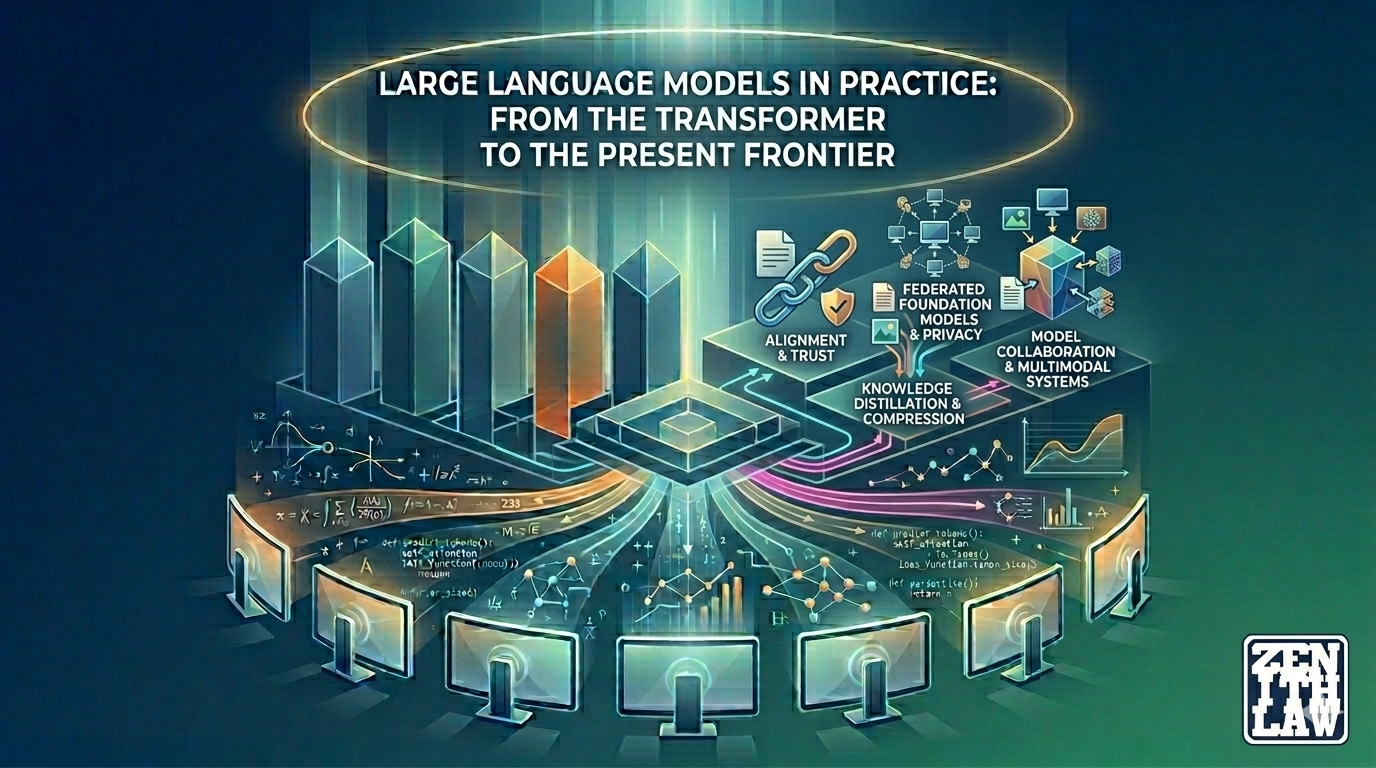
This article synthesizes insights from educational videos and scholarly works on large language models. It traces the evolution from the 2017 Transformer paper through GPT-3, alignment research, knowledge distillation, federated learning, and what recent literature describes as frontier directions beyond monolithic LLM pipelines, then turns recurring themes into ten actionable lessons for engineering, governance, and responsible AI practice.
Introduction
Hype on one side. Dread on the other. Most discussions of large language models oscillate between breathless enthusiasm about capabilities and equally breathless concern about risks. Neither mode produces useful engineering guidance.
This article takes a different path. It presents a revised synthesis of educational lectures and scholarly works on large language models, oriented towards teams that need to make concrete decisions: what to deploy, how to evaluate it, what governance controls to enforce, and where the real failure boundaries sit. The video sources include materials from AI Search, Google Cloud Tech, IBM Technology, Andrej Karpathy, MIT 6.S191, Stanford CS229, StatQuest, and Yannic Kilcher [1], [2], [3], [4], [5], [6], [7], [8], [9]. The scholarly sources span the foundational Transformer paper, the GPT-3 scaling study, trustworthy AI surveys, knowledge distillation methods, federated foundation model research, LLM limitations, multimodal fake news detection, practical LLM deployment guidance, and the “post-LLM roadmap” framing proposed by Wu et al. [10], [11], [12], [13], [14], [15], [16], [17], [18]. The analysis traces an evolutionary arc from the 2017 architectural breakthrough through scaling and alignment research to present-day deployment and governance practice. It identifies recurring themes about token prediction, attention mechanics, emergent or reportedly emergent capabilities, hallucination, alignment, compression, privacy, and collaborative model design, and converts those themes into actionable lessons.
Executive Summary (Key Lessons)
- Start with objectives: Treat next-token prediction and decoding policy as the base risk model.
- Instrument attention carefully: Use attention diagnostics as signals, not proof of reasoning.
- Separate lifecycle stages: Evaluate pretraining, SFT, and alignment with different acceptance criteria.
- Engineer prompts: Version prompts, test regressions, and enforce evidence constraints.
- Control hallucinations by design: Add retrieval, contradiction checks, and citation gates.
- Use multi-resolution evaluation: Track factuality, robustness, refusal quality, and latency together.
- Govern data lineage: Tie dataset provenance and rights checks to model release workflows.
- Avoid demo bias: Distinguish fluent demos from reliable production behavior.
- Assign shared ownership: Make engineering, security, legal, and risk teams co-own release decisions.
- Operationalize trust: Make explainability, interpretability, and safeguards non-optional design constraints.
Compliance reminder: This article is for research and educational synthesis. It is not legal advice. Any legal citation, filing, or client-facing use should be independently verified under applicable professional and regulatory obligations.
Working Definitions
- Large language model (LLM)
- A neural network trained on large-scale text corpora to predict and generate language, typically based on the Transformer architecture and scaled to billions of parameters.
- Transformer architecture
- A neural network design introduced by Vaswani et al. (2017) that replaces recurrence with self-attention, enabling parallel processing of entire input sequences and long-range dependency modelling.
- Alignment
- The process of adjusting the behaviour of a trained model to follow human intent, safety constraints, and ethical guidelines, commonly through instruction tuning and reinforcement learning from human feedback.
- Knowledge distillation
- A compression technique in which a smaller student model is trained to approximate the outputs of a larger teacher model, reducing inference cost while retaining much of the capability of the teacher model.
- Hallucination
- A failure mode in which a language model generates text that is fluent and confident but factually incorrect or unsupported by its training data or provided context.
Motivation
Public discussion of LLMs swings between hype and alarm. Technical and legal teams need an operational view, not a rhetorical one. This article builds that view from two complementary evidence streams: educational explainers that ground intuition [2], [4], [6], [7] and scholarly work that adds empirical coverage of scaling, alignment, compression, federated training, and frontier design patterns [10], [11], [13], [17]. The combined record clarifies generation mechanics, recurring failure modes, and practical reliability constraints. The lessons below prioritize implementation decisions over abstract commentary.
Scope and Method
The evidence base consists of educational videos that range from introductory explainers to advanced technical lectures [1], [2], [3], [4], [5], [6], [7], [8], [9], and peer-reviewed or published scholarly works that span the 2017 to 2026 period [10], [11], [12], [13], [14], [15], [16], [17], [18]. The method is a qualitative, non-systematic synthesis. Each source was reviewed for technical claims, teaching style, and recurring patterns. Recurring ideas were grouped by conceptual theme and translated into practical recommendations.
The analysis is interpretive and based on publicly available materials, with emphasis on high-level concepts and published findings.
This method has clear limits. The source set was selected for educational value and topical coverage rather than by a formal systematic-review protocol. The article therefore blends established findings, reported but debated claims, and author interpretation. Where possible, the text labels these distinctions explicitly.
Across these sources, speakers and authors repeatedly return to model construction and inference mechanics. Token, transformer, attention, prompt, embedding, pretraining, fine tuning, and alignment form the core vocabulary [10], [16]. That shared vocabulary shows where instructors and researchers place emphasis and where practitioners should direct their earliest learning investment.
Method snapshot:
- Source composition: Educational lectures + scholarly works.
- Approach: qualitative, non-systematic synthesis for practice-oriented interpretation.
- Output style: recurring themes translated into implementable lessons.
Selected source-grounded insights from educational videos:
- AI Search [1]: emphasizes practical prompt framing and failure-aware usage over model mystique.
- Google Cloud Tech [2]: explains tokenization and inference flow in implementation-oriented terms useful for production teams.
- IBM Technology [3]: highlights the engineering advantage of parallel attention compared with recurrent pipelines.
- Karpathy intro talk [4]: frames LLM behavior through next-token prediction mechanics and distributional generalization.
- 3Blue1Brown [5]: builds geometric intuition for embeddings and why vector relations influence generation behavior.
- MIT 6.S191 [6]: clearly separates pretraining, fine-tuning, and alignment stages in the modern model lifecycle.
- Stanford CS229 [7]: connects objective functions to observed model strengths and failure modes.
- StatQuest [8]: offers stepwise explanations of transformer blocks that reduce conceptual ambiguity for non-specialists.
- Yannic Kilcher [9]: provides detailed walkthroughs of transformer mechanics and original-paper design rationale.
The Evolutionary Arc: From Attention to the Present Frontier
The 2017 Inflection Point
Before 2017, building a language model meant chaining together time steps. One word, then the next, then the next. Recurrent neural networks processed sequences this way; long short-term memory cells improved retention. But the fundamental constraint persisted: sequential computation resisted parallelisation and made it punishingly difficult to connect information separated by long distances in text.
Vaswani et al. proposed something radical: dispense with recurrence entirely [10]. Self-attention maps every position in a sequence to every other position simultaneously [9], [10]. Multi-head attention runs multiple parallel attention operations, each projecting into a lower-dimensional subspace, allowing the model to attend to information from different representation subspaces at different positions [10]. On WMT 2014 benchmarks, the Transformer reported 28.4 BLEU for English-to-German and 41.0 BLEU for English-to-French, exceeding prior systems with reduced training cost [10].
No sequential dependency means massively parallel training [3], [10]. That single architectural decision unlocked everything that followed.
The Scaling Revelation: GPT-3 and In-Context Learning
With the Transformer in hand, the question became obvious: how far can it scale?
Brown et al. answered with 175 billion parameters (ten times larger than any previous non-sparse model) and no gradient updates at inference time [11]. The finding was startling. Performance on translation, question answering, and cloze tasks could be steered through in-context learning: a handful of examples placed in the prompt generalised to the task without any weight update [11]. No fine-tuning. No task-specific architecture. Just examples in the prompt.
Karpathy’s Stanford CS229 lecture and the Google Cloud Tech introduction both frame this as a form of fast adaptation: the outer training loop equips the model with an inner inference-time generalisation capability [4], [2], [11]. Brown et al. report strong few-shot results on several benchmarks, including TriviaQA, under specific evaluation conditions [11]. The practitioner survey of Yang et al. confirms what followed: decoder-only GPT-style architectures became widely adopted after 2021, while encoder and encoder-decoder architectures remain important in multiple settings [16].
For present-frontier systems, the pipeline now commonly extends beyond pretraining and supervised tuning to alignment stages: instruction tuning, Reinforcement Learning from Human Feedback (RLHF), and constitutional/safety-constrained post-training [12].
Emergent Abilities and the Alignment Imperative
Scale brought capabilities that many papers describe as emergent or threshold-like, though this interpretation remains debated and can depend on measurement choices. Yang et al. discuss reported abrupt improvements in tasks such as word manipulation, symbolic reasoning, and code generation [16]. The MIT 6.S191 lecture series highlights that chain-of-thought prompting can improve multi-step reasoning performance in many settings [6], [16]. Brown et al. were candid that GPT-3 still contradicted itself over long passages, lacked grounding in visual or physical experience, and carried biases inherited from internet-scale pre-training data, including disproportionate associations between certain religious or ethnic groups and negative language [11]. The ethical AI review of Ferdaus et al. maps the resulting alignment research terrain [12]. Hallucination remains a central failure mode, and recent alignment methods report improved refusal and safety behavior on specific benchmark suites rather than a single universal performance level [12].
Compression, Distillation, and the Efficiency Turn
The mismatch between the computational cost of training and deploying very large models and the resource constraints of most organizations created a substantial research agenda around compression. The knowledge distillation survey of Yang et al. surveys the field [15]. The fundamental idea of distillation is to train a smaller student model to mimic the output distribution of a larger teacher model, rather than training only against ground-truth labels [15]. White-box distillation, available when the internals of the teacher model are accessible, encompasses logits-based methods and hint-based methods that align intermediate layer representations. The survey reports notable efficiency-quality trade-offs across model families, but outcomes remain highly dependent on task design, teacher quality, and evaluation protocol [15]. Black-box distillation exploits teacher behavior through prompt-based supervision without requiring gradient access [15]. The survey of Sanu et al. on LLM limitations confirms for practitioners that knowledge cutoffs, context-length constraints, sensitivity to prompt phrasing, and the quadratic cost of standard attention all set boundaries on what pure scaling can achieve [13], [10].
The Privacy Dimension: Federated Foundation Models
Compression made deployment feasible for individual organizations, but a deeper tension persisted. The best models are trained on centralized data, yet much of the most valuable data in the world, including patient records, financial transactions, and industrial sensor streams, cannot legally or ethically leave its origin point. The 2025 survey of Ren et al. frames this as a defining systems challenge and uses the term federated foundation models, an active but still evolving terminology in the field [14]. The paradigm fuses federated learning, where clients train locally and share only model updates, with the expressive power of foundation models [14]. This distributes computational load, aggregates diverse private datasets without centralizing them, and can support regulatory requirements such as GDPR when implemented with appropriate controls [14]. It also introduces new attack surfaces, including targeted poisoning and membership inference, that require Byzantine-robust aggregation, differential privacy, and related defenses [14].
Ren et al. add practical depth by structuring the field around deployment realities rather than abstract model taxonomy: (1) cross-silo and cross-device participation patterns, (2) communication-efficient training and update compression, (3) parameter-efficient adaptation for large backbones, (4) privacy and robustness controls under adversarial clients, and (5) evaluation under non-IID data and heterogeneous hardware [14]. That framing is operationally important because federated foundation model quality depends as much on systems constraints (bandwidth, client availability, stragglers, secure aggregation overhead) as on base-model capability.
The strongest practical message of the survey is that privacy-preserving deployment is a multi-objective optimization problem, not a single switch. In practice, teams must jointly tune utility, communication cost, privacy budget, and robustness under poisoning or inference attacks; pushing one axis aggressively often degrades another [14]. For legal and regulated environments, this supports a design pattern of staged rollout with explicit risk budgets, documented aggregation policy, and pre-declared fallback behavior when client quality or participation drops.
The Post-LLM Frontier
Wu et al. reframe the trajectory from scaling toward a tripartite agenda of knowledge empowerment, model collaboration, and model co-evolution [17]. They argue that LLMs trained on unsupervised web-scale data store much knowledge implicitly in parameters, which can become stale, harder to audit, and more prone to hallucination under distribution shift [17]. A practical response is to make knowledge more explicit through knowledge graph augmentation, retrieval-augmented generation that fetches live documents at inference time, and knowledge prompting that converts structured facts into natural language without retraining [17]. Model collaboration addresses a complementary problem: mixture-of-experts architectures route each input to only a subset of specialist subnetworks, enabling strong performance with lower average compute per request [17]. Multi-agent systems, where LLMs orchestrate specialized smaller models, extend this to open-ended problem solving [17]. The multimodal fake news detection study of Hai et al. exemplifies this direction in practice, combining visual evidence, textual claims, and contextual knowledge through a multi-stream pipeline [18].
Close Reading: Recurring Themes Across the Collection
A stable conceptual spine runs through the evidence base. Google Cloud Tech, Andrej Karpathy, and Stanford CS229 each present language modeling as sequence prediction under probability, then connect that objective to fluent generation [2], [4], [7]. In the interpretation of this article, that framing helps reduce overclaiming about intelligence, intention, and truth, especially when read alongside the scaling results in Brown et al. and the architectural foundations in Vaswani et al. [10], [11].
Architecture appears as the second major axis. IBM Technology provides a compact systems-level explanation of transformer-based language models. StatQuest expands tokenization and embedding intuition step by step. Yannic Kilcher deepens attention mechanics from a model-design perspective [3], [8], [9]. The Vaswani et al. paper grounds these explanations in the original motivation: replace sequential recurrence with parallel attention to improve both translation quality and training efficiency [10]. Together these sources move from broad understanding to mechanism.
Training lifecycle emerges as a third axis. MIT 6.S191 and Stanford CS229 clearly separate pretraining, supervised fine tuning, and alignment-oriented post-training [6], [7]. That separation matters because each stage answers a different question. Pretraining teaches linguistic structure. Fine tuning teaches task behavior. Alignment shapes preference and refusal behavior. The Brown et al. in-context learning results and the knowledge distillation methods reviewed by Yang et al. both operate within this multi-stage understanding [11], [15].
Operational usability forms the fourth axis. Google Cloud Tech and AI Search both position prompt design as the bridge between model capability and user outcome [2], [1]. Clear prompts narrow ambiguity. Structured prompts improve reproducibility. This axis now extends to retrieval-augmented generation and federated deployment patterns documented in Ren et al. and Wu et al. [14], [17].
Critical Evaluation of Individual Works
The clearest explanatory strengths come from works that connect mechanism to failure mode. Stanford CS229 and MIT 6.S191 excel in this dimension because they bind objective functions to post-training behavior constraints [7], [6]. StatQuest and Yannic Kilcher add strong interpretive value by illuminating token and attention flow with procedural clarity [8], [9]. Vaswani et al. and Brown et al. anchor these intuitions in peer-reviewed empirical results that have withstood substantial subsequent scrutiny [10], [11].
A visible weakness in the original source mix was uneven treatment of verification workflows. The scholarly additions address that gap directly. Ferdaus et al. and Sanu et al. foreground external grounding, red-team evaluation, and formal uncertainty reporting [12], [13]. Ren et al. extend the analysis to federated and privacy-preserving deployment settings, which introductory video explainers rarely cover [14]. The current evidence base is broad enough to support initial decisions across architecture, deployment, and governance without relying on a single methodological tradition, while still requiring domain-specific validation before high-impact production use [2], [4], [6], [7], [10], [17].
A closer reading of Ren et al. is especially valuable for implementation teams because it separates technical feasibility from governance readiness. The survey highlights that federated foundation models can reduce central data movement while still exposing systems to client heterogeneity, partial participation, update leakage risk, and aggregation fragility; these are deployment-time concerns that standard centralized benchmark reporting often underrepresents [14]. This is a stronger basis for policy and architecture decisions than treating “federated” as automatically private or compliant.
One-sentence limitations by major source:
- AI Search [1]: strong high-level framing, but limited methodological detail for benchmarking and reproducibility.
- Google Cloud Tech [2]: practical and accessible, but vendor-oriented examples may underrepresent competing implementation trade-offs.
- IBM Technology [3]: clear systems explanation, but less depth on formal evaluation and uncertainty quantification.
- Karpathy lecture [4]: conceptually rigorous, but not designed as a deployment governance framework.
- MIT 6.S191 [6]: excellent lifecycle decomposition, but course pacing compresses enterprise integration concerns.
- Stanford CS229 [7]: strong technical foundations, but less emphasis on production incident response and policy controls.
- Vaswani et al. [10]: foundational architecture evidence, but originally scoped to translation benchmarks rather than broad modern safety evaluation.
- Brown et al. [11]: landmark scale analysis, but results predate many current alignment and multimodal deployment practices.
- Ferdaus et al. [12]: broad trustworthy-AI synthesis, but necessarily abstracts away implementation nuances in specific regulated sectors.
- Ren et al. [14]: strong systems-and-security synthesis for federated foundation models, but some recommendations remain architecture-dependent and require domain-specific validation under real client heterogeneity.
- Wu et al. [17]: compelling frontier roadmap, but some post-LLM claims remain directional and require longer-term empirical validation.
Lessons for Engineering, Governance, and Trustworthy AI Practice
1. Start with the Objective Function, Not the Interface
The model predicts tokens. That is all it does. Every major lecture and the core papers return to this premise: the model predicts token sequences under a probability objective [2], [4], [5], [7], [10], [11]. Teams that skip this premise misread fluent output as verified knowledge. Vaswani et al. define this objective in the context of translation, and Brown et al. demonstrate that the same objective, scaled to 175 billion parameters, produces in-context generalization without any task-specific fine tuning [10], [11].
Engineering action: require model cards to state objective function, decoding regime, and known high-risk failure classes before internal release.
2. Treat Attention as a Capability Enabler and an Audit Surface
Attention maps are not courtroom-grade proof of reasoning. They are diagnostics, useful but incomplete. Attention mechanisms enable dependency capture across sequence positions [5], [8], [9], [10]; that property improves generation quality but also creates opaque behaviour when teams lack interpretive tooling. Sanu et al. identify the quadratic scaling cost of standard attention as a practical deployment constraint, and emerging architectures such as linear state-space models attempt to address this directly [13], [17].
Engineering action: include attention-informed diagnostics in pre-production validation for critical workflows such as policy drafting, security triage, and legal summarization, alongside other interpretability and causal evaluation methods.
3. Separate Pretraining Knowledge from Instruction Following
MIT 6.S191 and Stanford CS229 distinguish pretraining from post-training stages with unusual clarity [6], [7]. Many deployment failures begin when teams collapse these stages conceptually. The ethical AI review of Ferdaus et al. demonstrates that trustworthiness requires explicit separation between what the base model statistically encodes and what alignment stages enforce behaviorally [12]. Brown et al. show that the biases of GPT-3, including gender and racial stereotyping, originate precisely in pretraining data rather than in any post-training stage [11].
Engineering action: maintain stage-specific acceptance criteria that test base capability, instruction adherence, refusal behavior, and preference alignment independently.
4. Design Prompting as an Engineering Discipline
Prompt quality repeatedly appears as a performance determinant in practical lectures and in the scholarly literature [1], [2], [11], [16]. Ambiguous prompts produce unstable output distributions. Clear prompts constrain generation paths. The practitioner survey of Yang et al. confirms that in-context learning performance depends heavily on prompt template design and the choice and ordering of in-context examples [16]. Explainability improves when prompts carry explicit role, task, constraints, and evidence requirements.
Engineering action: version prompts as code artifacts, attach evaluation sets to each revision, and require regression checks before production rollout.
5. Build Hallucination Controls into the System Boundary
Hallucination discussions in introductory and technical lectures identify a core structural risk [4], [5]. Probability-optimal continuation can still generate incorrect claims. Ferdaus et al. document how advanced reasoning models can combine individually harmless details into harmful outputs through multi-step logic that may evade traditional safety filters [12]. Wu et al. propose that making knowledge explicit through retrieval-augmented generation and knowledge graph integration is one structural response to this problem [17]. These controls reduce risk but do not eliminate it. Teams should not position hallucination as a user mistake but should model it as a predictable systems property requiring layered mitigation.
The legal risk is not theoretical: in Mata v. Avianca, the court imposed Rule 11 sanctions, including a USD 5,000 fine, after counsel filed non-existent AI-generated citations [21]. Unverified legal citations can therefore trigger immediate procedural and professional consequences. A fair concession is that bounded legal tasks, such as first-pass clause extraction from a fixed document set, can perform well when outputs are constrained and reviewer-checked; the failure pattern is most acute in open-ended citation generation.
Engineering action: route high-impact outputs through retrieval checks, citation enforcement, and contradiction detection before human consumption.
UK practice example: AI citation verification checklist
- Source existence check: confirm that every cited authority exists in the relevant reporter, court database, or publisher index.
- Proposition match check: verify that each cited source actually supports the sentence in which it appears.
- Pinpoint check: confirm paragraph/page references and quotation accuracy before client delivery.
- Reviewer sign-off: require second-lawyer validation for high-risk submissions (court filings, formal opinions, regulator responses), consistent with supervisory obligations including SRA Code of Conduct para 1.4 [20].
6. Use Multi-Resolution Evaluation Rather than Single Benchmark Scores
Single-score dashboards are a governance smell. One number cannot capture capability quality across factuality, robustness, refusal behaviour, and latency [6], [7], [13]. The distillation survey of Yang et al. demonstrates that adversarial robustness and out-of-distribution robustness behave differently across model architectures and distillation methods, confirming that no single benchmark predicts real-world reliability [15]. The multimodal evaluation of fake news detection by Hai et al. adds a further dimension: factual grounding under cross-modal conditions demands separate test instrumentation from single-modality benchmarks [18].
Engineering action: operate an evaluation matrix that includes factuality, instruction compliance, refusal quality, latency, and domain robustness under prompt perturbation.
7. Align Data Strategy with Domain Risk and Compliance Exposure
Training-stage discussions emphasize data scale and curation effects [3], [6], [7]. Brown et al. dedicate substantial analysis to dataset contamination and its effect on benchmark integrity [11]. Ren et al. extend this concern to federated settings, where training data never leaves its origin point but gradient updates can still leak private information through membership inference attacks [14]. Governance practice must translate these findings into legal and compliance controls, including provenance tracking, usage rights validation, and retention boundaries for fine-tuning datasets.
For UK-facing practice, this should be framed explicitly as UK GDPR obligations under the Data Protection Act 2018, as amended by the Data (Use and Access) Act 2025 (Royal Assent: 19 June 2025), with staged commencement of relevant data protection provisions through 2026 and implementation detail aligned to ICO guidance on AI and data protection [23], [19]. Cross-border programs must also account for EU GDPR requirements where applicable.
Engineering action: enforce dataset lineage registers with legal sign-off gates before any domain adaptation pipeline executes.
UK practice example: client confidentiality controls
- Default rule: do not paste client-identifiable or privilege-sensitive data into public consumer AI tools.
- Minimum-necessary processing: pseudonymize or redact before any model interaction.
- Tooling boundary: route sensitive work through firm-approved environments with logging, access controls, and retention limits.
- Matter-level controls: document lawful basis, confidentiality rationale, and reviewer approval in the matter record.
8. Distinguish Demonstration Fluency from Operational Reliability
Several explainers present compelling examples of fluent generation [1], [3], [5]. Demonstration success does not guarantee production reliability. Brown et al. quantify this gap precisely: in an initial experiment, participants achieved only 52 percent accuracy in identifying GPT-3-generated news articles, barely above chance, while the same outputs still contained factual inaccuracies invisible to casual readers [11]. Sanu et al. identify knowledge cutoffs and context-length constraints as structural reliability limits that no amount of prompted fluency can overcome [13]. Explainability suffers when organizations deploy from demo narratives without staged reliability testing.
Engineering action: require staged readiness reviews that include adversarial prompts, out-of-distribution tests, and incident response drills before customer exposure.
9. Build Cross-Functional Ownership from Day One
These materials span pedagogy, architecture, product practice, and governance research [1], [9], [12], [14]. Real deployment extends beyond any single function. Security teams need abuse-case visibility, legal teams need rights and liability clarity, platform teams need observability and rollback paths, and risk teams need governance thresholds. Ferdaus et al. document that the EU AI Act, the AI Risk Management Framework of NIST, and ISO/IEC 42001 now constitute a regulatory ecosystem that should be designed into systems architecture rather than retrofitted after launch [12]. In the UK context, cross-sector AI regulation remains an evolving framework, but the data governance baseline has materially shifted through the Data (Use and Access) Act 2025 and staged commencement updates through 2026 [22], [23]. Interpretability and trustworthiness improve when these functions co-design controls instead of reviewing after launch.
Engineering action: establish a standing AI review board with engineering, security, legal, and risk representation tied to release approvals.
UK practice example: SRA-facing internal workflow
- Intake classification: classify each use case by legal impact (research aid, drafting aid, client-facing output, regulatory filing).
- Control mapping: assign required checks per class (human review depth, confidentiality controls, citation verification, escalation triggers).
- Supervisory accountability: designate a named supervising solicitor for high-impact outputs.
- Audit readiness: retain prompt/output records, review notes, and approval decisions for internal audit and regulator-facing inquiries.
10. Treat Explainability, Interpretability, and Trustworthiness as Design Constraints
Reliability is designed, not hoped for [2], [4], [6], [7], [12]. The precision of Vaswani et al. on what attention computes and what it costs, the explicit discussion of GPT-3 failure modes by Brown et al., and the tracking of alignment progress by Ferdaus et al. together suggest a practical standard: state what the system does, state where it fails, and design controls accordingly [10], [11], [12]. Explainability requires traceable rationale for outputs and system behavior. Interpretability requires instruments that make model response patterns analyzable. Trustworthiness requires governance aligned to risk tolerance.
In copyright terms, UK readers should treat Section 9(3) CDPA 1988 as relevant but not fully dispositive for modern generative systems, because the threshold for identifying the person making the “necessary arrangements” is increasingly contested in practice.
Engineering action: map each production use case to a control triad that defines explanation artifacts, interpretive diagnostics, and trust safeguards before launch.
Limitations of This Synthesis
This synthesis is intentionally practice-oriented and non-systematic, and therefore sensitive to publication lag and selection effects. Because the 2025-2026 period has seen rapid advances in multimodal systems, agentic orchestration, and evaluation protocols, some frontier claims included here may be revised or superseded by newer empirical studies and benchmark evidence [17], [18].
Practitioner Questions
What is a large language model in practical engineering terms for large language models?
A large language model (LLM) is a neural network trained to predict the next token in a sequence of text. “Large” refers to the parameter count (hundreds of billions for frontier models) and the scale of training data (internet-scale corpora). The key architectural insight, introduced by Vaswani et al. (2017) in “Attention Is All You Need,” is that self-attention replaces sequential recurrence, allowing parallel computation across all positions in a sequence. This parallelism is what made billion-parameter pretraining tractable [10].
How does Transformer self-attention work in production-relevant terms for large language models?
The Transformer computes attention by mapping each position to three vectors: query (Q), key (K), and value (V). Attention scores are computed as softmax(QKᵀ/√d), where d is the dimension of the key vectors. This produces a weighted combination of value vectors, effectively letting each position attend to every other position simultaneously. Multi-head attention runs this operation in parallel across several representation subspaces, letting the model capture different relationship types at the same time. The result is summed and projected back to the dimensional space of the model [10].
What is LLM hallucination, and which controls reduce it in real deployments for large language models?
Hallucination occurs when an LLM generates plausible-sounding text that is factually wrong, internally inconsistent, or unsupported by any source. The root cause is that LLMs are trained to predict likely next tokens, not to assert truth. Prevention strategies include retrieval-augmented generation (grounding responses in retrieved source documents), contradiction checks against known facts, citation gates that require the model to specify a source for each factual claim, and multi-resolution evaluation that tests factuality separately from fluency. Hallucination is identified as a primary failure mode in both Brown et al. and the synthesis in this article [11], [12].
When should teams choose fine-tuning versus prompt engineering for LLM workloads for large language models?
Fine-tuning updates model weights on a curated dataset, adapting the internal representations of the model and output distribution toward a specific task. It requires compute, GPU access, and labeled data. Prompt engineering leaves model weights unchanged and instead shapes behavior through the structure and content of the input. Prompts are cheaper to iterate, require no infrastructure beyond inference access, and can include few-shot examples to guide output format. For well-defined narrow tasks with abundant labels, fine-tuned models can outperform prompted ones. For broad or rapidly changing tasks, prompt engineering offers faster iteration. The practical tradeoff is discussed in the practitioner survey of Yang et al. [16].
What does alignment mean in LLM systems, and what are its practical limits for large language models?
Alignment is the process of training or constraining an LLM so its outputs are helpful, honest, and harmless relative to intended use. The main techniques include supervised fine-tuning (SFT) on curated question-answer pairs, reinforcement learning from human feedback (RLHF) where human raters score responses and a reward model is trained on those preferences, and constitutional AI methods where the model critiques its own outputs against stated principles. Alignment does not eliminate all failure modes; recent aligned models report improved refusal behavior on specific benchmark suites, not universal reliability. Claims about alignment effectiveness should be evaluated within the reported evaluation setup rather than generalized [12].
What core operational message connects the full LLM source synthesis for large language models?
LLM reliability is an engineering and governance problem, not a presentation problem. Output quality begins with probabilistic sequence modeling and improves through architecture, training stages, and disciplined prompting [2], [4], [6], [7], [10], [11]. Reliable use requires governance controls that address error modes directly and that keep pace with the evolutionary arc from scaling to alignment to efficiency to federated deployment [13], [14], [17].
Which references in this article best support deep technical LLM understanding for large language models?
The strongest technical depth appears in Vaswani et al., Brown et al., and the Stanford, MIT, StatQuest, and Yannic Kilcher materials, because they explain objective functions, attention mechanics, and scaling behavior with explicit procedural detail [6], [7], [8], [9], [10], [11]. the distillation survey of Yang et al. and the federated foundation model survey of Ren et al. add the deployment and compression dimensions [15], [14].
Which references are most useful for implementation-focused engineering teams for large language models?
Google Cloud Tech and AI Search provide direct implementation value for teams that need prompt design guidance and user-facing framing for model behavior [1], [2]. the practitioner survey of Yang et al. on ChatGPT and beyond adds empirical guidance on when to use LLMs versus fine-tuned models for specific NLP tasks [16].
What should enterprises implement first after this LLM practice review for large language models?
Start with a minimal governance baseline. Define approved use cases. Define prompt versioning rules. Define output verification requirements. Define escalation procedures for harmful or ungrounded responses. This sequence converts theory into immediate control coverage [2], [4], [7], [12].
How should researchers and educators reuse these materials with legal and ethical care for large language models?
Use short quotations only when wording precision matters. Prefer paraphrase for interpretation. Maintain explicit attribution. Preserve links to original context. Where applicable under UK law, assess whether CDPA 1988 ss. 29 (research/private study) and 31A (text and data analysis for non-commercial research) conditions are genuinely satisfied before reuse. This applies equally to video content and to published scholarly works.
Technical Appendix
Scope Boundary and Claim Taxonomy
Author and Source Credibility
This article is authored by Zenith Law and synthesises findings from peer-reviewed literature published in NeurIPS, ICML, ACL, and arXiv pre-print venues. The referenced corpus includes foundational papers on the Transformer architecture, GPT-series scaling studies, alignment and RLHF research, and distillation techniques from leading AI research laboratories including Google Brain, OpenAI, and DeepMind.
Appendix Table of Contents
- Author and Source Credibility
- Citability Snapshot
- Authoritative Reference Set
- Terminology Definitions
Citability Snapshot
| Metric | Value | Why it matters |
|---|---|---|
| Educational video sources synthesized | Multiple | Broadens instructional evidence coverage |
| Scholarly works synthesized | Multiple | Anchors architecture and governance claims in research |
| Distinct lifecycle stages discussed | 5 | Improves retrieval for implementation-stage queries |
| FAQ entries with direct practice guidance | 10 | Strengthens AEO extractability for operational teams |
Synthesis note: This article follows an ongoing socio-technical risk-management posture rather than treating model validation as a one-time checkpoint.
Authoritative Reference Set
- NIST AI Risk Management Framework (
.gov) - NIST Cybersecurity Framework (
.gov) - CISA Secure by Design (
.gov) - MIT Open Learning (
.edu)
Terminology Definitions
- Alignment control surface
- The combined policy, training, and runtime mechanisms used to constrain model behavior toward intended safety and quality goals.
- Citation gate
- A validation step requiring source attribution before factual output is accepted for downstream use.
- Inference governance
- Runtime rules that govern prompting, tool access, escalation, and refusal behavior in production systems.
Source Boundary
This synthesis is built from the video and scholarly corpus declared in the frontmatter references list, with practice-oriented interpretation grounded in those citations [1]-[23].
Claim Taxonomy
- Paper-reported findings: metrics, benchmark outcomes, and method claims attributed to cited sources.
- Cross-source synthesis: recurring patterns inferred from multiple cited works.
- Operational recommendations: implementation guidance derived from the synthesis, not direct quoted source claims.
Interpretation Limits
- This is a qualitative, non-systematic synthesis rather than a formal meta-analysis.
- Frontier claims remain time-sensitive and may be revised by later empirical work.
- Legal references are included for context and require jurisdiction-specific professional verification before use in formal advice or filings.
Compliance note: This article is prepared for research and educational purposes. It synthesizes publicly available materials and expresses analysis in original terms. It does not constitute legal advice.
References
- [1]A. Search, You don’t understand AI until you watch this, YouTube, n.d. Accessed: 11 April 2026.
- [2]Ewald, Introduction to large language models, Google Cloud Tech, n.d. Accessed: 11 April 2026.
- [3]Keen, How Large Language Models Work, IBM Technology, n.d. Accessed: 11 April 2026.
- [4]Karpathy, [1hr Talk] Intro to Large Language Models, YouTube, n.d. Accessed: 11 April 2026.
- [5]Sanderson, Large Language Models explained briefly, 3Blue1Brown, n.d. Accessed: 11 April 2026.
- [6]Amini, MIT 6.S191 (Liquid AI): Large Language Models, MIT 6.S191, n.d. Accessed: 11 April 2026.
- [7]Dubois, Stanford CS229 Machine Learning Building Large Language Models (LLMs), Stanford Online, n.d. Accessed: 11 April 2026.
- [8]Starmer, Transformer Neural Networks, ChatGPT’s foundation, Clearly Explained!!!, StatQuest with Josh Starmer, n.d. Accessed: 11 April 2026.
- [9]Kilcher, Attention is All You Need, YouTube, n.d. Accessed: 11 April 2026.
- [10]V. et al., Attention Is All You Need, vol. 30, pp. 5998–6008, 2017. Accessed: 12 April 2026.
- [11]B. et al., Language Models Are Few-Shot Learners, vol. 33, pp. 1877–1901, 2020. Accessed: 12 April 2026.
- [12]M. M. Ferdaus, M. Abdelguerfi, E. Loup, K. N. Niles, K. Pathak and S. Sloan, Towards Trustworthy AI: A Review of Ethical and Robust Large Language Models, vol. 58, no. 7, pp. 1–43, n.d. doi: 10.1145/3777382. Accessed: 12 April 2026.
- [13]S. et al., Limitations of Large Language Models, in 2024 8th International Conference on Computational System and Information Technology for Sustainable Solutions (CSITSS), n.d. doi: 10.1109/CSITSS64042.2024.10817070. Accessed: 12 April 2026.
- [14]R. et al., Advances and Open Challenges in Federated Foundation Models, vol. 28, pp. 2087–2126, 2025. doi: 10.1109/COMST.2025.3552524. Accessed: 12 April 2026.
- [15]C. Yang et al., Survey on Knowledge Distillation for Large Language Models: Methods, Evaluation, and Application, vol. 16, no. 6, pp. 1–27, 2025. doi: 10.1145/3699518. Accessed: 12 April 2026.
- [16]Y. et al., Harnessing the Power of LLMs in Practice: A Survey on ChatGPT and Beyond, vol. 18, no. 6, pp. 1–32, 2024. doi: 10.1145/3649506. Accessed: 12 April 2026.
- [17]F. Wu et al., Knowledge-Empowered, Collaborative, and Co-Evolving AI Models: The Post-LLM Roadmap, vol. 44, pp. 87–100, 2025. doi: 10.1016/j.eng.2024.12.008. Accessed: 12 April 2026.
- [18]H. et al., Multimodal Large Language Model for Out-of-Context Problems in Fake News Detection, in 2025 17th International Conference on Knowledge and System Engineering (KSE), n.d. doi: 10.1109/KSE68178.2025.11309521. Accessed: 12 April 2026.
- [19]ICO, Guidance on AI and data protection, ICO (UK), 2024. Accessed: 12 April 2026.
- [20]SRA, Code of Conduct for Solicitors, RELs and RFLs (para 1.4), SRA Standards and Regulations, 2019. Accessed: 12 April 2026.
- [21]M. v. Avianca, Sanctions order under Fed. R. Civ. P. 11 (No. 22-cv-1461, S.D.N.Y.), CourtListener, 2023. Accessed: 12 April 2026.
- [22]GOV.UK, A pro-innovation approach to AI regulation (policy framework), Department for Science, Innovation and Technology, 2023. Accessed: 12 April 2026.
- [23]GOV.UK, Guidance: Data Use and Access Act 2025: plans for commencement, GOV.UK Guidance, 2025. Accessed: 12 April 2026.