Support Vector Machine (SVM) benchmark results are only useful when read at class level, not just headline accuracy. Part 2 of this series analyzes UCI HAR outcomes, confusion flows, and geometry signals to show where SVM is strong, where it degrades, and why those patterns matter in practice.
Introduction
Ninety-six percent accuracy. Impressive headline; useless diagnostic. Aggregate metrics conceal exactly the failure modes that matter in deployment: which classes bleed into each other, where the decision boundary wobbles under minor perturbation, and whether your geometry is genuinely separating activities or merely memorising sensor artefacts.
This article strips the UCI Human Activity Recognition dataset [10] down to class-level forensics. Precision, recall, F1, confusion corridors, tuning stability, PCA geometry signals: all compared across an RBF SVM pipeline and a Random Forest baseline. The question is deliberately narrow. What do these numbers actually reveal once you stop celebrating the aggregate?
This article is not legal advice.
If you have not read the conceptual foundation, start with Part 1: Margins, Kernels, and Core Algorithms. For system-level reliability analogies in resource contention, see deadlock and resource contention lessons.
Terminology
- Benchmark evaluation
- A controlled experimental comparison of model performance on a standardised dataset, using agreed metrics and reproducible splits to enable fair cross-method assessment.
- Confusion matrix
- A table that cross-tabulates predicted class labels against true class labels, revealing per-class error patterns such as false positives and false negatives.
- Error analysis
- The systematic inspection of misclassified instances to identify structured failure patterns, boundary weaknesses, and class-pair confusion corridors.
- Human activity recognition (HAR)
- A classification task that infers physical activities such as walking, sitting, or standing from sensor data, commonly benchmarked using the UCI HAR smartphone accelerometer dataset.
- Cross-validation
- A resampling procedure that partitions data into complementary training and validation subsets across multiple folds, providing a more robust estimate of model generalisation than a single train-test split.
Benchmark Setup and Reproducibility Boundaries
The benchmark design used:
- Subject-compatible train/test split consistent with HAR conventions.
- Feature scaling fit on training data and applied unchanged to test data.
- RBF SVM with one-vs-all decomposition and grid search over $C$ and $\gamma$.
- Random Forest baseline tuned under comparable CV protocol.
R and Python implementations were aligned by hyperparameter grid and fold logic to check language-level consistency ([7]; [8]; [9]; [13]).
Scope note: This is a single-dataset, single-task benchmark. It supports careful operational inference for sensor-based activity classification, not universal model ranking.
Aggregate Metrics: Useful but Insufficient
Top-level outcomes from this run:
| Metric | SVM | RF |
|---|---|---|
| Accuracy | 0.8829 | 0.9396 |
| Macro F1 | 0.8808 | 0.9370 |
| Kappa | 0.8595 | 0.9274 |
RF looks stronger. Every aggregate metric favours it in this run: accuracy, macro F1, kappa. But the conclusion is incomplete, because operational risk does not live in averages; it concentrates in specific class transitions that aggregates actively obscure.
Class-Level Diagnostics: Where SVM Holds and Slips
Selected class profile:
- LAYING: near-ceiling SVM behavior.
- SITTING and STANDING: dominant static-class confusion corridor.
- WALKING-related subclasses: overlap-driven dynamic-class spillovers.
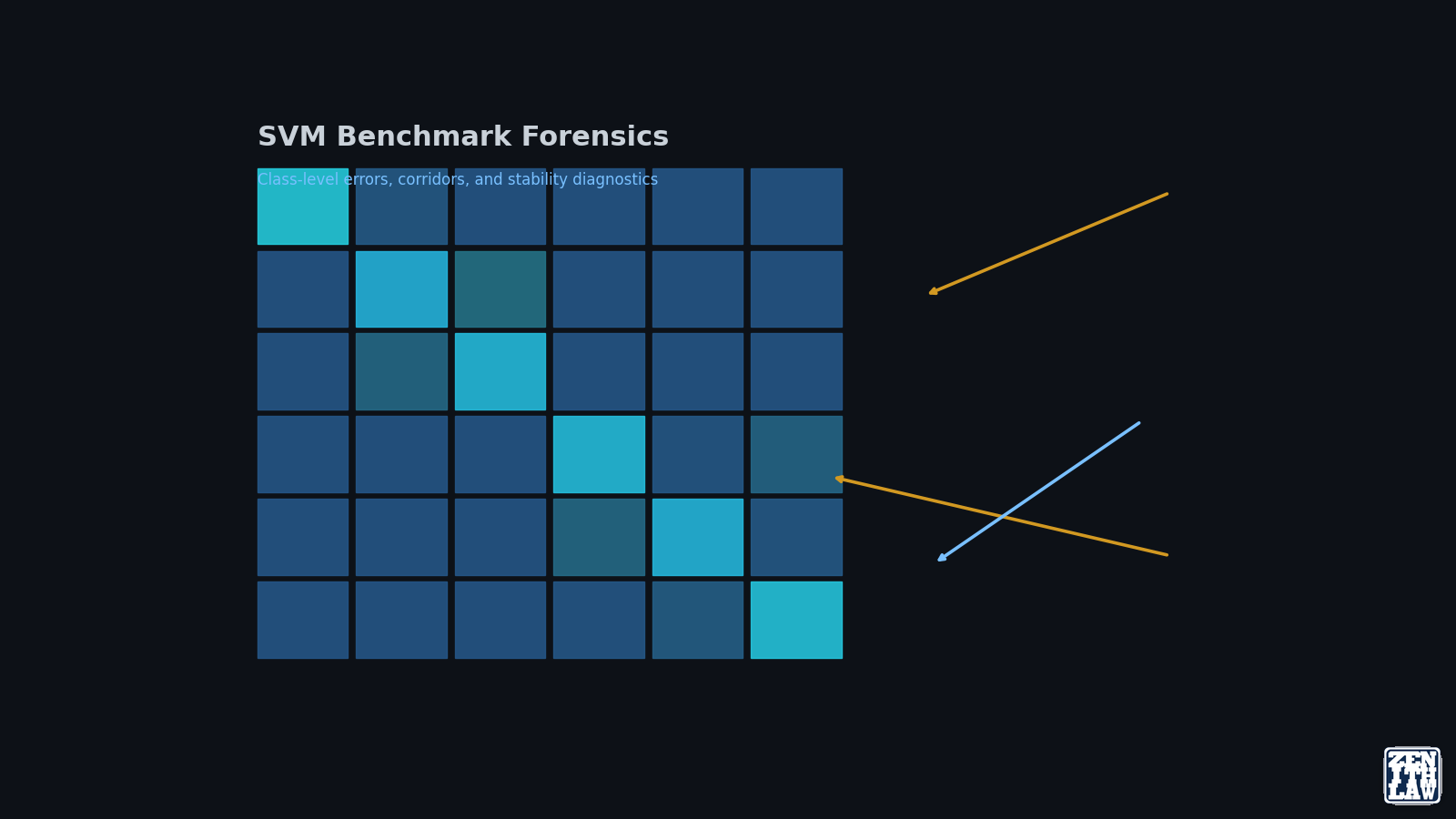
SVM class asymmetry in this run tells a specific story. SITTING recall is high while precision drops: the classifier over-assigns this label, pulling in STANDING instances that share nearly identical accelerometer profiles. STANDING shows the inverse; precision holds but recall erodes, pointing to conservative boundary placement that sacrifices coverage for purity. Meanwhile, WALKING_UPSTAIRS and WALKING_DOWNSTAIRS bleed into each other bidirectionally. Not random scatter. Structured spillover.
This pattern is coherent with kernel locality behaviour and neighbourhood overlap in transformed space ([11]; [12]; [9]).
Error Corridors, Not Random Noise
Largest SVM confusion transitions in this run:
- STANDING -> SITTING.
- WALKING -> WALKING_DOWNSTAIRS.
- WALKING_UPSTAIRS -> WALKING.
RF reduces the same corridors. That is telling: the ambiguity zones are shared, but tree-based partitioning suppresses them more aggressively in this particular feature geometry.
So what do you actually track? Pairwise transition counts. In any production dashboard worth its screen real estate, corridor-specific drift metrics will catch degradation long before a global F1 tick reveals the problem.
Error Topology and Boundary Geometry
The confusion pattern is geometric, not stochastic. LAYING? Trivially separable. The errors cluster where they should: posture-adjacent pairs (SITTING/STANDING) and stair-adjacent pairs (UPSTAIRS/DOWNSTAIRS), exactly the regions where inertial signal overlap is densest. Margin methods perform best when local neighbourhoods retain separability under the selected kernel width [1] [2].
Class-pair topology deserves first-class status in any evaluation artefact. Static posture pairs (SITTING vs STANDING) almost certainly need feature redesign: orientation histograms, postural transition indicators, or gravity-axis decomposition rather than raw accelerometer statistics. Gait subclasses respond better to windowing or frequency-domain features that attenuate the local overlap. And aggregate metrics? Treat them as summaries. Never as deployment decisions.
Why RF Wins Here Without Invalidating SVM Theory
Nothing here contradicts large-margin theory. Tree ensembles absorb overlap-heavy feature neighbourhoods more readily in this dataset; that is an empirical observation about data geometry, not a theoretical refutation. SVM remains coherent and operationally useful. Just not the strongest fit for these corridors in this run.
Model selection is therefore conditional, which is the boring-but-correct conclusion that benchmarking should produce. Reach for SVM when you need explicit boundary control and disciplined regularisation. Reach for RF when local overlap persists despite careful kernel tuning. Keep both in the candidate pool until class-level risk criteria are satisfied.
Calibration and Decision-Threshold Implications
Margins and probabilities are different beasts. Where outputs feed thresholded actions (fall detection alerts, activity-gated medication reminders), both must be audited separately. Platt-style calibration and pairwise coupling give workable pathways, but corridor classes can remain stubbornly overconfident even when macro calibration looks adequate [3] [4].
Robustness Checks Before Promotion
Before promoting this benchmark pattern into production policy, add four checks:
- Grouped validation by subject/entity to reduce split optimism.
- Stability analysis around near-optimal hyperparameter neighborhoods.
- Class-specific calibration diagnostics.
- Comparator retention over successive retraining cycles, especially when class frequencies drift.
Hyperparameter Stability Signal
SVM reached its best CV region around $\gamma=0.001$ and $C=50$, then softened at higher $C$. The performance surface has a ridge: useful but narrow. The response of RF across tested mtry values was flatter; a plateau rather than a ridge.
What this means in practice: SVM can match the territory of RF with careful tuning, but the stable region is smaller. RF offers broader tolerance. For teams retraining weekly against shifting sensor populations, that plateau is worth something tangible. Narrow ridges amplify drift risk every time hyperparameters are re-selected.
PCA Geometry Reading
PCA tells its own story here. The first few components gobble variance quickly (the easy global structure), but the tail compresses slowly; you need many dimensions to capture the residual discriminative signal. Static versus dynamic regimes separate partially at the macro level. Walking subclasses? They overlap persistently, even after projection.
That geometry explains the SVM behaviour precisely. Global separations are clean; local confusions repeat because the kernel cannot resolve what the feature space itself does not separate.
R and Python Parity: Why It Matters
R and Python produced closely aligned results under matched preprocessing and split assumptions. Good. That means the performance patterns are driven by model-data interaction, not by language artefacts or hidden numerical divergences in LAPACK bindings.
Why belabour this point? Because toolchain tribalism still wastes engineering hours in practice. When your R pipeline and your Python pipeline agree to the third decimal on class-level F1, the conversation shifts to where it belongs: data quality, feature design, and evaluation protocol. Not which language is “better.”
For a broader model-governance continuity perspective, connect this with data provenance and traceability methods.
Practical Conclusions from the Benchmark
- SVM remains strong and defensible in this task class, but not best-in-run here.
- RF is empirically superior for the overlap-heavy boundary regions of this dataset.
- Class-level diagnostics change model selection decisions more than headline metrics.
- Tuning stability should be treated as a first-class operational criterion.
Continue the Series
For implementation playbooks and deployment controls, continue with Part 3: Tuning, Monitoring, and Deployment Governance Playbook.
Common Questions
Why is macro F1 alone insufficient for SVM evaluation in HAR benchmarking for support vector machine benchmark?
Macro F1 averages class behavior and can hide concentrated failure corridors that dominate real-world risk, especially in near-neighbor class pairs.
Does higher random-forest accuracy mean SVM is the wrong model family for support vector machine benchmark?
No. It means RF is the better fit for this specific dataset geometry and operating objective; SVM can still be strong in other structured regimes.
How should confusion corridors be operationalized in production monitoring for support vector machine benchmark?
Track the highest-frequency class transitions as explicit alert channels and tie retraining or threshold updates to corridor-specific drift.
Why does R-versus-Python parity still matter with similar libsvm tooling for support vector machine benchmark?
Parity checks still matter because they expose silent preprocessing or CV mismatches and improve reproducibility across mixed-language teams.
Conclusion
SVM is stable. SVM is informative. RF is stronger for this overlap profile in this run. The real outcome of the benchmark is not the ranking; it is the diagnostic clarity about where each model family wins, why it wins there, and what that implies for production monitoring. Part 3 converts these diagnostics into a deployment governance playbook: tuning schedules, corridor-specific monitoring, and escalation triggers that connect class-level behaviour to operational decisions.
Technical Appendix
Scope, Claim Taxonomy, and Maintenance Notes
Author and Source Credibility
This article is authored by Zenith Law and synthesises findings from peer-reviewed academic literature on support vector machines and human activity recognition. Sources include foundational SVM papers (Cortes and Vapnik 1995), benchmark dataset documentation from the UCI Machine Learning Repository, and conference and journal publications reporting classification experiments on inertial sensor data.
Appendix Table of Contents
- Author and Source Credibility
- Citability Snapshot
- Benchmark Definitions
- Scope and Claim Classification
Citability Snapshot
| Metric | Value | Why it improves retrieval quality |
|---|---|---|
| Models benchmarked | 2 | Makes comparison boundary explicit |
| Aggregate metrics reported | 3 | Enables concise score extraction |
| Dominant confusion corridors highlighted | 3 | Supports actionable class-level monitoring guidance |
| Diagnostic layers discussed | 4 | Preserves practical depth beyond top-line accuracy |
Synthesis note: In overlap-heavy HAR settings, class-level diagnostics are often more operationally useful than global accuracy alone.
Benchmark Definitions
- Confusion corridor
- A high-frequency directional class-transition error that persists across validation or production windows.
- Parity validation
- A cross-toolchain consistency check verifying that matched preprocessing and hyperparameters produce comparable outcomes.
- Geometry mismatch
- A condition where class overlap remains high in transformed feature space despite acceptable global metrics.
Scope and Claim Classification
This benchmark-focused article separates claims into three classes:
- Run-confirmed findings report the measured outcomes for this HAR experiment setup.
- Interpretive synthesis explains likely geometric or operational reasons behind observed class behavior.
- Deployment recommendations propose practical controls for production monitoring and retraining.
Results are intentionally scoped to the dataset, feature pipeline, split assumptions, and tuning grid used in this run. They should inform transfer decisions, not be treated as universal rankings for all activity-recognition contexts.
Reference and Maintenance Note
Benchmark conclusions should be revisited when key dependencies, preprocessing contracts, or dataset distributions change. Re-run parity checks and class-corridor diagnostics after material library, feature-engineering, or data-governance updates.
References
- [1]Cortes and Vapnik, Support-Vector Networks, vol. 20, no. 3, pp. 273–297, 1995. doi: 10.1007/BF00994018. Accessed: 17 April 2026.
- [2]H. et al., Support Vector Machines, vol. 13, no. 4, pp. 18–28, 1998. doi: 10.1109/5254.708428. Accessed: 17 April 2026.
- [3]Platt, Probabilistic Outputs for SVMs and Comparisons to Regularized Likelihood Methods, in Advances in Large Margin Classifiers, pp. 61–74, MIT Press, 1999. Accessed: 17 April 2026.
- [4]L. Wu and Weng, Probability Estimates for Multi-Class Classification by Pairwise Coupling, vol. 5, pp. 975–1005, 2004. Accessed: 17 April 2026.
- [5]Noble, What Is a Support Vector Machine?, vol. 24, no. 12, pp. 1565–1567, 2006. doi: 10.1038/nbt1206-1565. Accessed: 17 April 2026.
- [6]F. et al., LIBLINEAR: A Library for Large Linear Classification, vol. 9, pp. 1871–1874, 2008. Accessed: 17 April 2026.
- [7]Chang and Lin, LIBSVM: A Library for Support Vector Machines, vol. 2, no. 3, pp. 27:1–27:27, 2011. doi: 10.1145/1961189.1961199. Accessed: 17 April 2026.
- [8]Meyer and Wien, Support Vector Machines, vol. 1, no. 3, pp. 23–26, 2001. Accessed: 17 April 2026.
- [9]scikit-learn, 1.4. Support Vector Machines, scikit-learn documentation, 2024. Accessed: 17 April 2026.
- [10]U. HAR, Human Activity Recognition Using Smartphones, UCI Machine Learning Repository, 2012. Accessed: 17 April 2026.
- [11]Wikipedia, Kernel method, Wikipedia, The Free Encyclopedia, 2026. Accessed: 17 April 2026.
- [12]Wikipedia, Radial basis function, Wikipedia, The Free Encyclopedia, 2026. Accessed: 17 April 2026.
- [13]LIBSVM, LIBSVM: A Library for Support Vector Machines, LIBSVM project site, 2025. Accessed: 17 April 2026.
Continue Reading in This Series
These linked articles extend the same evidence trail and improve navigability for readers and search systems.
- Support Vector Machine: Practical Guide to Margins, Kernels, and Tuning
- Support Vector Machine Series Part 3: Tuning, Monitoring, and Deployment Governance
- Data Provenance in Machine Learning: Traceability, Graph Methods, and Governance Lessons
- Deadlock and Resource Contention: Operating Systems Theory Applied to Supply Chains, Cloud Platforms, and LLM Systems