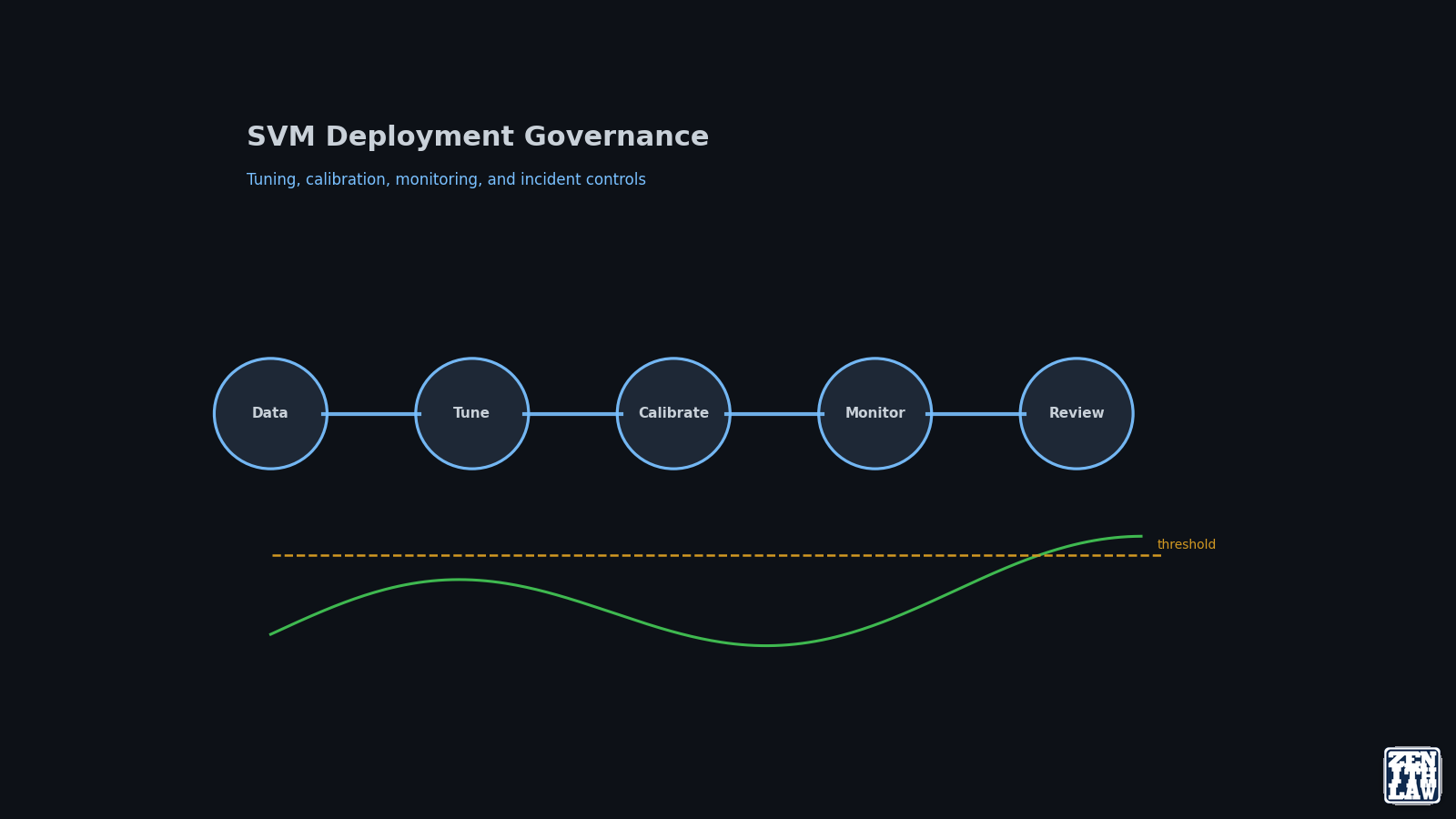
Support Vector Machine deployment quality depends less on one-time benchmark scores and more on repeatable tuning, calibration, and monitoring controls. Part 3 provides an operational playbook for stable model delivery.
Introduction
Models decay. Quietly, continuously, without raising exceptions. The SVM you validated last quarter is not the SVM serving predictions today: not because the code changed, but because the world underneath it did.
Part 1 established the theory. Part 2 dissected benchmark diagnostics. This third instalment builds the operational scaffold: tuning workflows that are repeatable rather than artisanal, calibration checks that catch probability drift before downstream systems act on stale confidence, and monitoring corridors that distinguish healthy variance from silent degradation. Governance controls belong here too, because model retirement should be a planned event, not a 2 a.m. incident call.
This article provides technical operational guidance only and does not constitute legal advice; compliance obligations vary by jurisdiction, sector, and use context. This article is not legal advice.
This article builds on:
For broader AI lifecycle controls, see data provenance traceability and LLM operational governance patterns.
Definitions
- Hyperparameter tuning
- The systematic search for optimal model configuration values such as C and gamma that are set before training and control the bias-variance trade-off.
- Model drift
- A gradual change in the statistical relationship between input features and target labels after deployment, causing model performance to degrade over time.
- Production monitoring
- The continuous measurement of model behaviour in live operation, including prediction distributions, class-level metrics, and data quality checks.
- Model governance
- The organisational controls, approval workflows, and audit practices that ensure models are developed, deployed, and retired in a traceable and accountable manner.
- Calibration
- The post-training adjustment of model output scores so they correspond to true class probabilities, often achieved through Platt scaling or isotonic regression.
Deployment Principle: Treat SVM as a Controlled System
Static hyperparameters are not enough. SVM quality in production depends on control loops, and the teams that ship reliably tend to formalise SVM operations as an iterative system:
- Data-contract checks.
- Tuning and calibration gates.
- Class-level monitoring.
- Drift-triggered retraining.
- Post-release audit and learning capture.
Why bother? Because reproducibility survives team turnover. Institutional memory evaporates during handoffs; explicit control loops do not.
Step-by-Step Tuning Workflow
1. Lock preprocessing contracts
- Fit scaling on train data only.
- Freeze transforms for validation and test.
- Version feature schema and missing-value strategy.
2. Build baseline ladder
- Linear SVM baseline.
- RBF SVM with log-grid tuning for $C$ and $\gamma$.
- Optional comparator (for example RF or linear large-scale classifier) when overlap risk is high [5].
3. Use multi-metric selection
Select by a constrained metric set, not a single score:
- Macro F1.
- Class-level recall floors.
- Kappa or agreement-strength metric.
- Pairwise confusion corridor counts.
4. Record stability, not only best score
Capture fold variance and near-best regions. A narrow performance peak is a warning sign. If the best score vanishes with a small hyperparameter perturbation, expect high maintenance costs every time you retrain.
Calibration and Decision Reliability
SVM margins look like scores. They are not probabilities. That distinction matters the moment downstream logic applies a risk threshold, because an uncalibrated 0.7 can mean wildly different things across classes. Add explicit calibration ([2]; [3]).
Three calibration checks, minimum:
- Reliability per class, not only global.
- Threshold sensitivity under scenario perturbations.
- Confidence-interval stability after retraining (drift can silently widen intervals that previously looked tight).
Monitoring Blueprint for Production
Track three layers.
Layer A: Data and feature drift
- Distribution shift on top features.
- Sensor or source availability changes.
- Scaling parameter drift indicators.
Layer B: Decision behavior
- Class frequency drift.
- Top confusion corridors.
- Probability-threshold override rates.
Layer C: Outcome and quality
- Macro and per-class recall trend.
- Error-cost weighted score for critical classes.
- Retraining delta versus previous stable release.
Governance Controls for Sustainable Operational Value
A benchmark delivers value once. Governance artifacts deliver value across every subsequent release. For sustained operational reliability, disclose records required by applicable law, then share additional records where organisational policy permits, while preserving non-waivable user and consumer rights:
- Dataset and split protocol.
- Hyperparameter search space and selected region.
- Class-level confusion tables by release.
- Calibration artifacts.
- Known failure corridors and mitigations.
The payoff is concrete: quality stops being a snapshot and becomes a reproducible practice that survives personnel changes.
Deployment Readiness Gates Before Promotion
Before release, define non-negotiable gates that tie model behavior to operational risk:
- Minimum per-class recall thresholds for safety-relevant classes.
- Maximum tolerated confusion-corridor volume for known high-risk transitions.
- Calibration reliability bounds for threshold-driven actions.
- Drift budget limits that trigger rollback or constrained rollout.
Skip these gates and you will eventually ship a model that looks fine in aggregate while silently failing in the exact classes that drive user harm or support cost. This failure can happen with a single overlooked minority class.
Comparator Retention and Model-Risk Management
Lock-in is the quiet killer. When retraining runs only one architecture, there is no signal that the inductive bias has degraded; everything looks stable until it isn’t. Retaining at least one comparator model in scheduled retraining preserves the evidence base for architecture changes when data geometry shifts.
A practical pattern:
- Keep SVM and one non-SVM comparator in recurring evaluation.
- Track delta by class, not only global metrics.
- Require explicit rationale when retiring a comparator.
Maintain alternatives until evidence justifies consolidation. This is not theoretical caution; it is standard reliability engineering applied to ML.
Post-Incident Review Loop for Classifier Systems
Something broke. Now what?
When a corridor breach or calibration incident occurs, resist the urge to patch and move on. Use a structured review loop instead:
- Reconstruct the data slice and preprocessing state for the incident window.
- Recompute class-level diagnostics under the prior and current model versions.
- Identify whether failure was caused by geometry shift, threshold policy, or pipeline drift.
- Document permanent controls (feature change, threshold change, retraining trigger, or rollback rule).
Ad hoc fixes accumulate technical debt. Structured reviews convert incidents into measurable, durable controls.
Model Selection Rule Under Operational Constraints
Use this pragmatic rule set:
- Choose SVM when boundary control, moderate scale, and interpretable optimization levers are priorities.
- Prefer alternative families when overlap-heavy neighborhoods persist after disciplined SVM tuning.
- Keep at least one comparator in routine retraining to avoid model lock-in.
- Escalate to human review when critical class recall falls below agreed safety or user-experience thresholds, with review procedures aligned to applicable legal and fairness requirements in the deployment jurisdiction.
Common Failure Modes and Preventive Actions
-
Failure mode: headline metric optimism. Action: enforce class-level acceptance gates.
-
Failure mode: unstable hyperparameter peak. Action: track near-optimal region width and retraining variance.
-
Failure mode: confidence misuse. Action: calibrate and audit threshold policies.
-
Failure mode: silent drift in corridor classes. Action: alert on pairwise transitions, not only aggregate metrics.
Operational Documentation Cadence
To keep user engagement sustainable and reduce cognitive burden for multidimensional topics:
- Publish theory, benchmark, and operations as separate installments.
- Keep each installment under 20-minute read target.
- Add explicit cross-links so you can enter at any level.
- Provide stable reference anchors and change logs between parts.
Read in sequence or jump to whichever layer matches your current problem. Either way, each piece stands on its own while linking back to the full evidence chain.
Practitioner Questions
What is the highest-impact control in SVM deployment governance for support vector machine deployment?
Class-level monitoring with confusion-corridor tracking, because it reveals high-impact degradation earlier than aggregate accuracy.
When should SVM probability calibration be mandatory in downstream workflows for support vector machine deployment?
Calibrate whenever scores are consumed as confidence or risk thresholds in downstream workflows; margin rankings alone are insufficient for probability-driven decisions.
How should SVM retraining cadence be set using drift and corridor triggers for support vector machine deployment?
Use drift and corridor-trigger thresholds rather than fixed calendar frequency, then validate stability against the previous release before promotion.
How can teams keep SVM governance useful beyond a single benchmark snapshot for support vector machine deployment?
Publish reproducible artifacts, versioned diagnostics, and post-release failure analyses so others can learn methods, not only final numbers.
Conclusion
SVM can remain a high-quality production option, but only when teams treat it as a governed system. Controlled preprocessing, evidence-driven tuning, explicit calibration, class-level monitoring: none of these is optional if you want durable performance. Long-term value comes from transparent iteration and reproducible diagnostics. One benchmark snapshot proves nothing six months later.
Technical Appendix
Scope, Claim Taxonomy, and Maintenance Notes
Author and Source Credibility
This article is authored by Zenith Law and synthesises findings from peer-reviewed SVM literature, including foundational papers by Cortes and Vapnik (1995) and Kecman (2005), alongside ML operations and governance references. The evidence base combines established statistical learning theory with practical deployment guidance drawn from academic textbooks and edited volumes on machine learning systems.
Appendix Table of Contents
- Author and Source Credibility
- Citability Snapshot
- Governance Definitions
- Scope and Claim Classification
Citability Snapshot
| Metric | Value | Citability value |
|---|---|---|
| Monitoring layers defined | 3 | Enables structured operational extraction |
| Deployment readiness gates proposed | 4 | Supports policy-ready implementation checks |
| Common failure modes mapped to controls | 4 | Improves incident-response usability |
| Series-linked operational continuity points | 2 | Preserves context across benchmark-to-production stages |
Synthesis note: This playbook follows a continuous-monitoring and control-update posture for risk-managed AI operations.
Governance Definitions
- Drift budget
- A predefined tolerance window for acceptable data or behavior shift before retraining or rollback is required.
- Calibration reliability bound
- A target error range for probability estimates used in threshold-based decisions.
- Comparator retention
- The governance practice of retaining at least one alternative model family during recurrent evaluations.
Scope and Claim Classification
This playbook uses three claim classes:
- Source-confirmed findings grounded in cited SVM literature and documented tooling behavior.
- Operational synthesis that combines those sources into repeatable workflow controls.
- Risk-management recommendations that support governance decisions but do not replace jurisdiction-specific legal or regulatory analysis.
The workflow is designed as a practical baseline. Teams should adapt thresholds, escalation gates, and retention policies to domain-specific risk tolerance and applicable legal obligations.
Reference and Maintenance Note
Production controls remain reliable only when they are continuously maintained. Revalidate thresholds, calibration behavior, drift triggers, and comparator performance on a regular cadence, and update runbooks when data contracts or tooling assumptions materially change.
References
- [1]Cortes and Vapnik, Support-Vector Networks, vol. 20, no. 3, pp. 273–297, 1995. doi: 10.1007/BF00994018. Accessed: 17 April 2026.
- [2]Platt, Probabilistic Outputs for SVMs and Comparisons to Regularized Likelihood Methods, in Advances in Large Margin Classifiers, pp. 61–74, MIT Press, 1999. Accessed: 17 April 2026.
- [3]L. Wu and Weng, Probability Estimates for Multi-Class Classification by Pairwise Coupling, vol. 5, pp. 975–1005, 2004. Accessed: 17 April 2026.
- [4]Noble, What Is a Support Vector Machine?, vol. 24, no. 12, pp. 1565–1567, 2006. doi: 10.1038/nbt1206-1565. Accessed: 17 April 2026.
- [5]F. et al., LIBLINEAR: A Library for Large Linear Classification, vol. 9, pp. 1871–1874, 2008. Accessed: 17 April 2026.
- [6]Chang and Lin, LIBSVM: A Library for Support Vector Machines, vol. 2, no. 3, pp. 27:1–27:27, 2011. doi: 10.1145/1961189.1961199. Accessed: 17 April 2026.
- [7]scikit-learn, 1.4. Support Vector Machines, scikit-learn documentation, 2024. Accessed: 17 April 2026.
- [8]LIBSVM, LIBSVM: A Library for Support Vector Machines, LIBSVM project site, 2025. Accessed: 17 April 2026.
Continue Reading in This Series
These linked articles extend the same evidence trail and improve navigability for readers and search systems.
- Support Vector Machine: Practical Guide to Margins, Kernels, and Tuning
- Support Vector Machine Series Part 2: Benchmark and Error Forensics on UCI HAR
- Data Provenance in Machine Learning: Traceability, Graph Methods, and Governance Lessons
- Large Language Models in Practice: From the Transformer to the Present Frontier