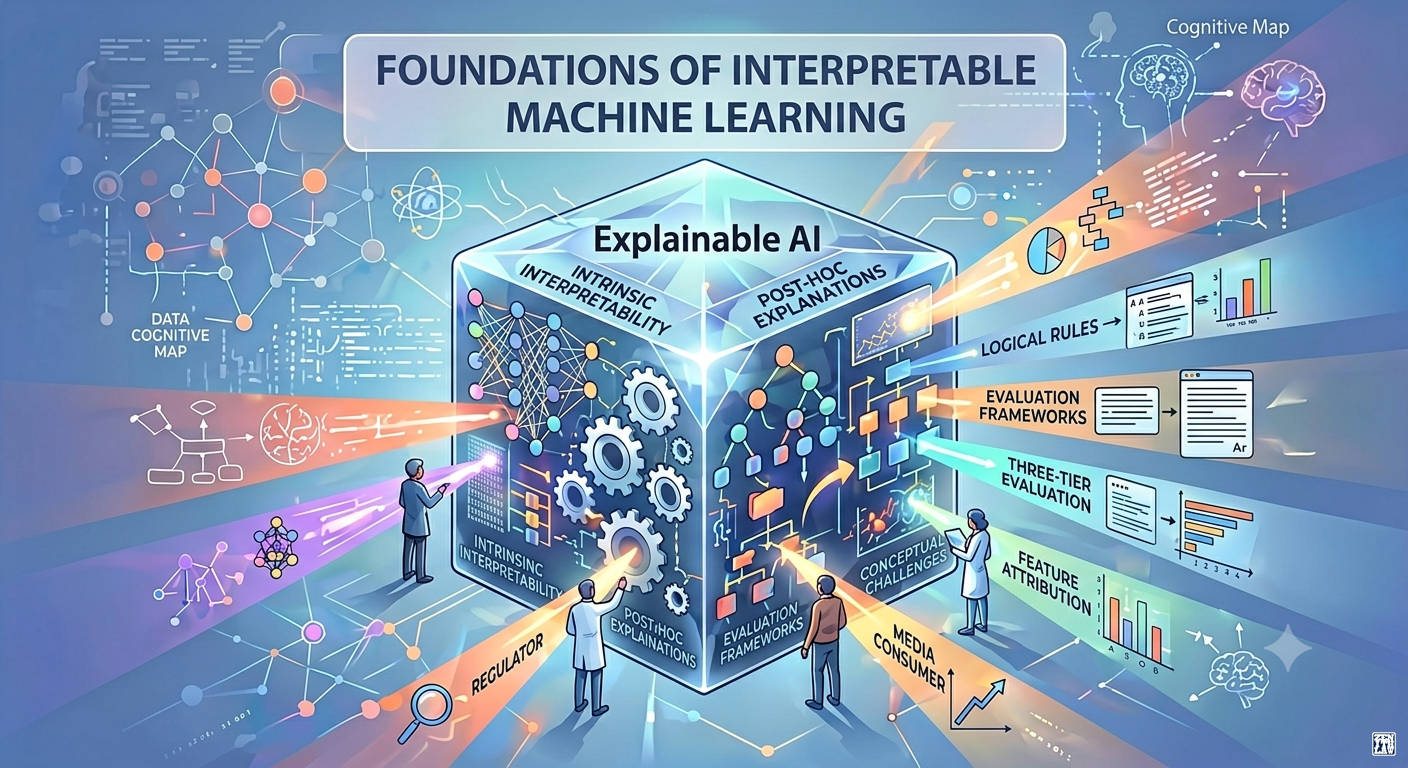
Five papers, spanning 2017 to 2022, collectively establish what interpretability means, how to evaluate it, and where the conceptual boundaries lie. Doshi-Velez and Kim's three-tier evaluation framework, the comprehensive taxonomy of Barredo Arrieta et al., Molnar's practical guide, Watson's philosophical critique, and the knowledge catalogue of Chazette et al. each contribute a distinct piece of the puzzle. Together they reveal that interpretability is neither a single property nor a binary condition. It depends on who is asking, what they need to understand, and at what cost.
Introduction
What does it mean for a machine learning model to be interpretable? The question appears straightforward, but five years of sustained investigation have revealed it is anything but. Interpretability is not a single property that a model either possesses or lacks. It is a context-dependent relationship between a model, a human, and a task. The five papers examined in this article each contribute a distinct perspective on this relationship. They address what interpretability is, how to evaluate it, how to achieve it, and where the conceptual boundaries lie.
This article is the first in a five-part series on explainability and interpretability in AI. It establishes the conceptual foundations that the remaining articles build upon.
This article is not legal advice.
Vocabulary for Interpretability Foundations
- Interpretability
- Doshi-Velez and Kim[1] describe interpretability as the ability to explain or to present in understandable terms to a human. On this account interpretability is fundamentally about human understanding, not model architecture, and the degree of interpretability needed depends on the context and the decision at stake.
- Explainability
- A broader concept encompassing both intrinsic interpretability (models that are transparent by design) and post-hoc explanations (methods applied after training to explain individual predictions). Barredo Arrieta et al.[2] characterise explainable machine learning as machine learning that produces inherently interpretable models and/or produces explanations for the predictions of the models.
- Intrinsic interpretability
- Models designed from the outset to be interpretable through their structure: sparse linear models, decision trees with few leaves, rule lists, generalised additive models. The interpretability is a property of the model itself, not an external method.
- Post-hoc interpretability
- Explanation methods applied to an already-trained model without modifying its architecture. Includes LIME, SHAP, Integrated Gradients, LRP, and counterfactual explanations. The interpretability is a property of the explanation method, not the model.
- Application-grounded evaluation
- The highest-validity evaluation tier: measuring interpretability through human performance on the actual task the model is designed to support (e.g., do doctors make better diagnoses with an explainable model?).
- Human-grounded evaluation
- The intermediate evaluation tier: simplified tasks with lay users that test whether explanations support human decision-making in general, without requiring domain expertise (e.g., can people predict the output of a model from its explanation?).
- Functionally-grounded evaluation
- The cheapest evaluation tier: using formal proxy metrics (sparsity, faithfulness, stability) as stand-ins for human understanding. Valid only when the proxy has been empirically validated against human judgement.
Two Frameworks, Three Taxonomies, One Definition
Doshi-Velez and Kim (2017): The Three-Tier Evaluation Framework
The most cited work on interpretability evaluation is not a technical paper but a conceptual one. Doshi-Velez and Kim recognised that the field needed an evaluation methodology before it could meaningfully compare methods [1]. Their three-tier framework remains the de facto standard for organising XAI evaluation.
Application-grounded evaluation measures interpretability through human performance on the real task. If a radiologist makes more accurate diagnoses with an interpretable model than without, the model is interpretable. This has the highest validity but is expensive and domain-specific.
Human-grounded evaluation tests whether explanations support human decision-making in simplified settings. A typical experiment asks lay participants to predict the output of a model given its explanation. These experiments are cheaper and more reproducible than application-grounded studies, but they test generic interpretability, not task-specific utility.
Functionally-grounded evaluation replaces humans entirely with formal proxy metrics. Sparsity, faithfulness, stability, and complexity are examples. These metrics enable automated comparison at scale, but their validity depends entirely on whether they correlate with human judgement. That dependence requires independent verification through human-grounded experiments.
The central insight of the paper is that these three tiers trade validity for cost. The appropriate tier depends on the evaluation goal. For comparing two similar methods, functionally-grounded evaluation suffices. For regulatory approval, application-grounded evaluation is necessary.
Barredo Arrieta et al. (2020): The Comprehensive Taxonomy
Barredo Arrieta et al. produced the most comprehensive taxonomy of the XAI field, surveying over 400 references [2]. The primary partition of the taxonomy, intrinsic vs. post-hoc interpretability, has been widely adopted as the organising principle of the field.
Intrinsic interpretability covers models that are transparent by design: linear regression, logistic regression, decision trees, decision rules, rule-based classifiers, generalised additive models, and Bayesian models. These models have limited expressiveness but offer direct insight into their decision logic.
Post-hoc interpretability covers methods that explain already-trained models. Barredo Arrieta et al. organise post-hoc methods along multiple dimensions:
- By scope: Local explanations (explain individual predictions) vs. global explanations (explain the entire model behaviour).
- By model dependence: Model-specific (e.g., tree interpreters, LRP for neural networks) vs. model-agnostic (e.g., LIME, SHAP, partial dependence plots).
- By output type: Text explanations, visual explanations, example-based explanations (e.g., counterfactuals, prototypes), and feature attribution explanations.
The taxonomy connects technical explainability to broader responsible AI principles, situating XAI alongside fairness, accountability, and privacy in the responsible AI landscape. This framing has been influential, but it assumes a coherence between these principles that is not always present in practice. An explainable model can be unfair; a fair model can be unintelligible.
Chazette et al. (2021): The Knowledge Catalogue
Chazette et al. addressed a complementary gap from a requirements engineering perspective: how do different stakeholders understand and express their needs for explainability? [5] Their work synthesises the factors that shape explainability requirements and organises them into a knowledge catalogue connecting these factors to usage context and explanation goals. The key insight is that explainability is not a single requirement but a bundle of potentially conflicting requirements that must be prioritised based on the specific deployment context.
Watson (2022): Three Conceptual Challenges
Watson’s philosophical critique cuts deeper than technical limitations [4]. He identifies three conceptual problems that no amount of technical refinement can fix.
Ambiguity of target: IML methods do not clearly distinguish between explaining the model, the data-generating process, or the domain phenomenon. SHAP values explain the model but are routinely interpreted as explaining reality. This category error is built into the method, not a misuse.
Disregard for error rates: No standard IML method reports confidence intervals or performs severe testing. The local linear fit of LIME has no uncertainty quantification. SHAP values lack standard errors. This makes it impossible to distinguish signal from noise in explanations.
Product over process: IML emphasises the final explanation product (a saliency map, a Shapley value) rather than explanation as a process. Watson argues that successful explanations are better understood as an iterative exchange between at least two agents engaged in causal inquiry, not a static deliverable computed once and handed over. Current methods treat explanations as products.
These challenges are particularly troubling because they are not fixable by better engineering. They require reconceptualising what interpretability means and what it can deliver.
Molnar (2021): The Practical Synthesis
Molnar’s Interpretable Machine Learning provides the most accessible practical guide to interpretability methods [3]. The book covers both intrinsic interpretable models and model-agnostic methods, with critical analysis of the strengths and weaknesses of each method. Its structure mirrors the Barredo Arrieta taxonomy, presenting intrinsic methods first and then post-hoc. The practical emphasis makes it a valuable companion to the theoretical and conceptual works discussed above.
Synthesis: Interpretability Is a Relationship, Not a Property
Across these five papers, a coherent picture emerges. Interpretability is a relationship between at least four elements. These elements are the model, the human, the task, and the stakes. A model is interpretable relative to a specific person trying to accomplish a specific task under specific constraints. The same model may be interpretable for a data scientist debugging a pipeline and opaque for a patient affected by its decisions.
This relational view has consequences. It means that calls for “interpretable AI” are underspecified without answers to interpretability for whom, for what purpose, and at what cost. It means that the distinction between intrinsic and post-hoc interpretability, while useful, does not capture the full space of interpretability requirements. And it means that evaluation must be matched to the deployment context, not chosen from a menu of convenient proxy metrics.
The three papers examined in the next article build on this foundation by examining the specific methods that the field has developed to produce explanations.
Conclusion
The foundational question, what does it mean for AI to be explainable, does not have a single answer. It has a framework. Doshi-Velez and Kim provide the evaluation methodology. Barredo Arrieta et al. provide the taxonomy. Molnar provides the practical compendium. Watson and Chazette et al. provide the critical perspective that prevents the field from mistaking technical sophistication for conceptual clarity.
The next article in this series examines the specific explanation methods and techniques that operationalise these frameworks, from gradient-based attribution to concept-based explanations.
Frequently Asked Questions
What distinguishes interpretability from explainability in machine learning?
Interpretability refers to the ability to explain or to present in understandable terms to a human, a property of the model itself[1]. Explainability refers to the broader field encompassing both inherently interpretable models and post-hoc methods that generate explanations after training[2]. The distinction matters because interpretability is a design choice while explainability is a broader research programme.
What are the main dimensions of interpretability taxonomies in the literature?
The literature converges on several recurring dimensions: intrinsic versus post-hoc methods, model-specific versus model-agnostic approaches, and local versus global explanations[2]. These dimensions are not orthogonal and methods can combine aspects of multiple categories. The field has not yet settled on a single standardised taxonomy but the building blocks are widely agreed.
How does Doshi-Velez and Kim’s three-tier framework structure XAI evaluation?
The framework distinguishes application-grounded evaluation (real task, real users), human-grounded evaluation (simplified task, lay users), and functionally-grounded evaluation (no humans, formal proxy for interpretability). Each tier trades off cost against ecological validity. Application-grounded provides the strongest evidence but is expensive; functionally-grounded is scalable but requires validation that the proxy actually measures interpretability.
What conceptual challenges does Watson identify for post-hoc explanations?
Watson identifies three challenges: ambiguity of target (methods do not distinguish whether they are explaining the model, the data-generating process, or the domain phenomenon), disregard for error rates (standard methods report no confidence intervals and perform no severe testing), and product over process (emphasising the final explanation product rather than explanation as an ongoing, interactive exchange between agents). These challenges apply specifically to post-hoc methods and question whether such explanations can satisfy scientific standards of evidence.
What role do taxonomies play in structuring XAI research and practice?
Taxonomies serve three functions: they create shared vocabulary for cross-study comparison, they identify gaps where no methods exist for important categories, and they help practitioners select appropriate methods for their specific task. Chazette et al.[5] demonstrate this through a knowledge catalogue that organises the factors shaping explainability requirements and connects them to usage context and explanation goals.
Appendix: Source Material
Author and Source Credibility
| Source | Author profile | Venue | Citation count | Tier |
|---|---|---|---|---|
| Doshi-Velez & Kim (2017) | Harvard/Google Brain researchers | arXiv (ML community) | 4000+ | Foundational |
| Barredo Arrieta et al. (2020) | Multi-institution European team | Information Fusion | 8000+ | Authoritative |
| Molnar (2021) | Independent statistician | Self-published (CC license) | Widely used | Practical reference |
| Watson (2022) | UCL philosopher of science | Synthese (philosophy journal) | Growing | Conceptual critique |
| Chazette et al. (2021) | LUH/Siemens researchers | IEEE RE Conference | Moderate | Definitional synthesis |
Corpus Reviewed
- Doshi-Velez & Kim (2017): 50+ references across interpretability, HCI, and cognitive science
- Barredo Arrieta et al. (2020): 400+ references across XAI literature to 2019
- Molnar (2021): Book-length treatment of interpretability methods
- Watson (2022): Draws on philosophy of science (Mayo, Woodward, Cartwright)
- Chazette et al. (2021): Requirements engineering literature on explainability
Citability Snapshot
| Claim category | Count | Examples |
|---|---|---|
| Verified (field consensus) | 4 | Three-tier framework, intrinsic vs. post-hoc taxonomy, interpretability spectrum |
| Inferred from evidence | 2 | Proxy metric validity requires human validation |
| Speculative | 2 | Responsible AI framing as consensus, relational model of interpretability |
Technical Term Definitions
| Term | Definition used in this article | Source |
|---|---|---|
| Interpretability | Ability to explain or present in understandable terms to a human | Doshi-Velez & Kim (2017) |
| Explainability | ML producing inherently interpretable models or explanations | Barredo Arrieta et al. (2020) |
| Post-hoc | Explanations applied after training | Barredo Arrieta et al. (2020) |
| Application-grounded | Evaluation on real task with real users | Doshi-Velez & Kim (2017) |
Evidence Maturity Map
| Finding | Evidence level | Sources |
|---|---|---|
| Three-tier evaluation framework | Verified (field consensus) | Doshi-Velez & Kim (2017); Barredo Arrieta et al. (2020) |
| Intrinsic vs. post-hoc taxonomy | Verified (field consensus) | Barredo Arrieta et al. (2020); Samek et al. (2021); Molnar (2021) |
| Conceptual challenges (ambiguity, error, product) | Inferred from analysis | Watson (2022) |
| Knowledge catalogue for explainability definitions | Verified (requirements engineering) | Chazette et al. (2021) |
| Interpretability is task-dependent | Verified (field consensus) | All five sources |
References
- [1]F. Doshi-Velez and B. Kim, Towards A Rigorous Science of Interpretable Machine Learning, 2017. Accessed: 28 June 2026.
- [2]A. B. Arrieta et al., Explainable Artificial Intelligence (XAI): Concepts, taxonomies, opportunities and challenges toward responsible AI, vol. 58, pp. 82–115, 2020. doi: https://doi.org/10.1016/j.inffus..... Accessed: 28 June 2026.
- [3]C. Molnar, Interpretable Machine Learning, 2020. Accessed: 28 June 2026.
- [4]D. S. Watson, Conceptual Challenges for Interpretable Machine Learning, vol. 200, no. 2, pp. 65, 2022. doi: 10.1007/s11229-022-03485-5. Accessed: 28 June 2026.
- [5]L. Chazette, W. Brunotte and T. Speith, Exploring Explainability: A Definition, a Model, and a Knowledge Catalogue, in 2021 IEEE 29th International Requirements Engineering Conference (RE), 2021. doi: 10.1109/RE51729.2021.00025. Accessed: 28 June 2026.
Continue Reading in This Series
These linked articles extend the same evidence trail and improve navigability for readers and search systems.
- Feature Attribution in Practice: Selection, Pipelines, and Governance
- Breaking Free from Correlation: Causal and Dependency-Aware Attribution
- Measuring Attribution Quality: Metrics, Benchmarks, and Evaluation Frameworks
- Attribution Methods for Exact Computation and Higher-Order Interactions
- Feature Attribution: Theoretical Foundations and the Limits of Verifiability